Why is Karachi a political orphan? Look at the public transport system

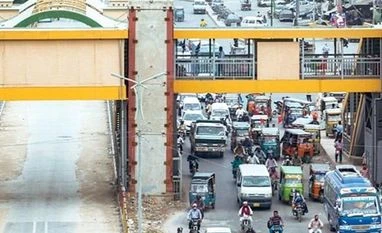
Incomplete roads in Karachi show what happens when a city becomes a political orphan
Karachi
Karachi ranks as having the worst public transport system globally, according to a 2019 study by car-parts company Mister Auto
Faseeh Mangi | Bloomberg
3 min read Last Updated : Nov 03 2020 | 2:09 AM IST
Muhammad Ali Jinnah Road has always had its share of traffic, but lately the main thoroughfare that connects central Karachi to its major port is in a state of near constant gridlock.
 
An elevated street eats up two of the road’s three lanes, but it’s empty — part of an incomplete project to create express lanes for public buses that was supposed to finish three years ago. It’s one of many towering structures scattered throughout the Pakistani city that were part of the latest plans to bring a modern transportation to Karachi, one of the world’s fastest-growing cities and the third-biggest by population.
 
Karachi ranks as having the worst public transport system globally, according to a 2019 study by car-parts company Mister Auto. Roads are filled with potholes, not all traffic signals are automated, and it’s common to see drivers running red lights. And yet the former capital is home to Pakistan’s main ports and the regional headquarters for companies such as Standard Chartered and Unilever , helping it generate half of the nation’s tax revenue. Those funds, however, get distributed to other parts of the country. The city’s outgoing mayor Waseem Akhtar said last year he had only 12 per cent administrative control of the city and a lack of funds.
 
“Karachi, despite its importance, is a political orphan,” said Arsalan Ali Faheem, a consultant at DAI, a Bethesda, Maryland-based company. “The federal government is limited in what it can do, and the city government controls less than a quarter of the city.” The dysfunction came into focus in August when record rainfall flooded many parts of the city. About 64 people died while 10,000 had to be rescued.
 
In its aftermath, Pakistan PM Imran Khan announced a development package valued at $6.8 billion jointly with the provincial government including the bus project and a circular railway system. The amount is more than $6 billion loan bailout Pakistan agreed from the International Monetary Fund to avoid bankruptcy.
 
The provincial government’s transport department has admitted it can’t do large projects on its own. Khan’s government announced 162 billion rupees for mega projects, but city officials reported that no funds were ever released earlier this year.

The government said in response that it has spent 24.65 billion rupees up to June, while an allocation of 17.9 billion rupees has been made for the current fiscal year.
 
The latest attempts follows others to bring Karachi’s transportation system into the modern era. Multiple bus projects have been announced but either they never started or were unable to sustain. Meanwhile, Lahore started a train service last week after getting a similar bus project running seven years ago.
 
The green line bus project was announced six years ago. It’s now expected to be completed around June of next year, said Asad Umar, Pakistan's federal planning minister and part of a Karachi committee . The delays are hardly an anomaly. The city’s most expensive area doesn’t have access to piped water and relies on water supplied through tankers, also known as “tanker mafia.” “An administrative setup that is unable to provide decent mass transit to the largest city in the country will always be viewed with skepticism,” said Uzair Younus, a non-resident senior fellow at the Atlantic Council.

One subscription. Two world-class reads.

Already subscribed? Log in

Subscribe to read the full story →
*Subscribe to Business Standard digital and get complimentary access to The New York Times

Smart Quarterly

₹900

3 Months

₹300/Month

SAVE 25%

Smart Essential

₹2,700

1 Year

₹225/Month

SAVE 46%
*Complimentary New York Times access for the 2nd year will be given after 12 months

Super Saver

₹3,900

2 Years

₹162/Month

Subscribe

Renews automatically, cancel anytime

Here’s what’s included in our digital subscription plans

Exclusive premium stories online

  • Over 30 premium stories daily, handpicked by our editors

Complimentary Access to The New York Times

  • News, Games, Cooking, Audio, Wirecutter & The Athletic

Business Standard Epaper

  • Digital replica of our daily newspaper — with options to read, save, and share

Curated Newsletters

  • Insights on markets, finance, politics, tech, and more delivered to your inbox

Market Analysis & Investment Insights

  • In-depth market analysis & insights with access to The Smart Investor

Archives

  • Repository of articles and publications dating back to 1997

Ad-free Reading

  • Uninterrupted reading experience with no advertisements

Seamless Access Across All Devices

  • Access Business Standard across devices — mobile, tablet, or PC, via web or app

Topics :karachi

Next Story



