Home / World News / Xi gives little reassurance on change in Covid, housing market policy
Xi gives little reassurance on change in Covid, housing market policy
Xi praised Covid Zero, his no-tolerance approach to containing infections, during a speech opening the 20th Communist Party congress in Beijing on Sunday
premium
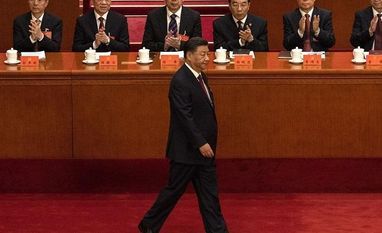
Xi Jinping at the National Congress of the Communist Party of China on Oct. 16.
4 min read Last Updated : Oct 17 2022 | 9:34 AM IST
Chinese President Xi Jinping signaled no change in direction for two main risk factors dragging down China’s economy -- strict Covid rules and housing market policies -- providing little lift to a worsening growth outlook.
Xi praised Covid Zero, his no-tolerance approach to containing infections, during a speech opening the 20th Communist Party congress in Beijing on Sunday, although he didn’t reference the virus again in sections laying out plans for the future. His slogans on China’s property market, meanwhile, repeated prior language even as the sector experiences its longest-ever slump due to policies aimed at curbing debt and financial risks.
Those two factors have been a major drag on the world’s second-largest economy, with economists surveyed by Bloomberg predicting growth of just 3.3% this year, the second-weakest pace in more than four decades. Third-quarter gross domestic product data, due to be released on Tuesday, will likely show a muted recovery from almost stagnant growth in the second quarter.
Xi’s report “is by no means a sharp turn from the previous policy stance,” wrote economists including Larry Hu, head of China economics at Macquarie Group Ltd., in a Sunday report. “The party congress is about long-term target and strategy, not about short-term policy adjustment.”
Traders have focused on other parts of Xi’s speech, seeing his comments about technology as an indication there may be support for the sector, which has come under assault from the US. Shen Meng, a director at investment bank Chanson & Co. in Beijing, said in the short term, the lack of direction on Covid Zero will drag on market sentiment.
Chinese stocks in Hong Kong and on the mainland fell in early trading Monday, though their losses trailed the broader decline in Asian equities. The onshore benchmark CSI 300 Index and the Hang Seng Index were both down 0.5% as of 9:41 a.m. in Shanghai, while the MSCI Asia Pacific Index dropped 1%.
Healthcare and information technology shares gained, despite overall weakness in the mainland stock market.
The government’s aggressive policy of restricting movement whenever virus cases emerge has led to surging unemployment among young jobseekers and a slump in business and consumer confidence. Housing sales have fallen as homebuyers grow increasingly reluctant to borrow and property developers fail to deliver projects as scheduled.
What Bloomberg Economics Says ...
“The clearest takeaway from Xi Jinping’s party congress speech is that growth remains a top economic priority. But he also used new language to describe ‘common prosperity’ that points to a continued tight regulatory stance and potentially major tax changes to spread wealth more evenly.”
-- Chang Shu and David Qu, economists
Few economists expect a significant rebound or a relaxation of Beijing’s stance that the sector needs to be regulated more tightly. That’s despite the government trying to stabilize the housing market by telling banks to lend more to property developers and encouraging local governments to reduce restrictions on housing purchases.
The text of Xi’s speech suggests that “the target of preventing excessively rapid gains in housing prices has been completed for now,” said Bruce Pang, chief economist at Jones Lang Lasalle Inc.
Policy Clues
While the speech lacked notable new details on those topics, Xi still asserted that economic development remains the Communist Party’s “top priority,” a sign the government will continue to prioritize GDP growth. Some analysts didn’t think Xi would stick to that slogan, and instead give stronger importance to national security. Xi mentioned twice the need to balance security and development in his speech.
“It’s important that he reiterated that development is the first priority,” said Ding Shuang, chief economist for Greater China and North Asia at Standard Charted Plc. “It emphasizes the importance of development, as people are having some doubt about that.”
Xi also said the country aims to have a GDP per capita on the level of a medium-developed country by 2035, words that have been used in China to refer to countries such as the Czech Republic and Slovakia.
There were no direct references to new policies, nor did Xi explicitly address pressing economic issues such as the ongoing strain on local government finances.
Economists instead were left to parse Xi’s speech for clues: A call to “regulate” income distribution and wealth accumulation, for example, “may trigger speculation over an upcoming inheritance tax,” Ding said.
Long-Term Growth
Xi offered an optimistic vision of China’s long-term growth, which he said would be fueled by a more skilled workforce, technological innovation and market reforms aimed at boosting productivity.
The speech signals a new phase of development “with more focus on productivity growth instead of capital expansion,” said Peiqian Liu, chief China economist at NatWest Group Plc.




