Brand value: Smaller banks take big steps
Experts, however, say perception can be different from reality
Somasroy Chakraborty Kolkata India's top banks are losing their global brand appeal, weighed down by mounting bad loans, reduced revenues, uncertain macro-economic environment and depreciating rupee. In contrast, and to the surprise of many experts, the country's smaller banks are increasing their brand value despite reporting lower profits and muted business growth.
India's largest lender and the most valuable banking brand - State Bank of India (SBI) - has seen nearly $2 billion erosion in its brand value, according to a recent report released by Brand Finance, a global brand valuation consultancy. The state-run lender's brand value is currently estimated at just over $4 billion compared to around $6 billion in 2013. SBI has also dropped out of the elite list of top 50 banking brands around the world and currently occupies the 54th position instead of 38.
The country's next two valuable brands - ICICI Bank and HDFC Bank - have also suffered losses in their brand value. ICICI Bank has moved out of the top 100 global banking brands and is ranked 107th now. HDFC Bank has slipped seven places to 133. The collective losses of top lenders means the total brand value of India's banks has shrunk 13 per cent or a net $1.83 billion in the last 12 months. India has now fallen behind Sweden and South Korea, and is currently 17th in terms of total national bank brand value.
"Since the detailed methodology is not available for evaluation it appears that aspects such as large international presence, currency exposure, management succession and non-performing asset performance could have played a part in the ranking. One of the factors is stakeholders' opinion. Big banks with large international investors could have suffered on account of stakeholders' analysis," Ashvin Parekh, managing partner at Ashvin Parekh Advisory Services LLP and a senior expert advisor on financial services at Ernst & Young in India, says.
Most industry analysts concede that the erosion in brand value reflects the trouble in the Indian banking sector. "This is hardly surprising with the non-performing asset worries and the uncertain outlook. Adverse publicity on account of Cobrapost (an online magazine that alleged top Indian banks of being involved in money laundering) and mis-selling concerns could have added further," Shinjini Kumar, leader - banking and capital markets at PwC in India, says.
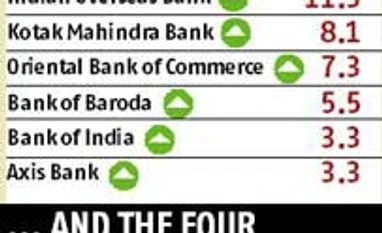
What surprised analysts was the way in which some of the mid and small-sized public sector banks increased their brand value. Union Bank of India was the star performer, growing its brand value by 49 per cent and becoming one of the top 10 banking brands in the country. Rivals IDBI Bank, Central Bank of India, Allahabad Bank, Indian Overseas Bank, Syndicate Bank and Oriental Bank of Commerce have all not only improved their brand value, but also bettered their global ranking and brand rating.
Brand Finance offers an explanation. "A major reason for the smaller banks increasing in value is that analysts are predicting higher forecasted revenues for these banks. In comparison, the forecasted revenues of the bigger banks have fallen, which implies that analysts are expecting the smaller banks to capture a bigger share of the market at the expense of the bigger banks," it says.
But not many local analysts are convinced and prefer to bet on bigger brands for improved earnings performance in the current uncertain economic environment.
Consider this: Angel Broking in a recent note to its clients cautioned that asset quality pressures are likely to persist for Union Bank. He, however, remains positive on ICICI Bank and HDFC Bank because of their superior asset quality, strong balance sheet and better earnings quality.
A similar view is echoed by Dhananjay Sinha, head of institutional research, economist and chief strategist at Emkay Global Financial Services. "Large private banks are exhibiting stronger capital adequacy and better credit risk management. I will rather align more towards large private banks instead of smaller public sector banks," he adds.
Analysts also point out that the recent performances of some of the top Indian banks have been better than their smaller domestic rivals. While the year-on-year growth in net profit of ICICI Bank and HDFC Bank in the first nine months of 2013-14 was 19 per cent and 27.2 per cent, respectively lenders like Allahabad Bank, Indian Overseas Bank, Syndicate Bank and Union Bank a reported 4-34 per cent decline in their profit after tax in the same period. Central Bank of India suffered a net loss of Rs 1,425 crore during the first nine months of this financial year.
It appears that perception of Indian banking brands is in contrast to their financial performance.

 "Brand value: Smaller banks take big steps")


 Connect with us on WhatsApp