HBO moves from niche to mass
The movie channel rebrands itself to appeal to a wider audience, beyond the metros
Urvi Malvania Mumbai Sometime last year, HBO conducted a survey of viewership patterns in India. It was looking at ways in which it could shore up viewership numbers which have been fluctuating over the past couple of years. The survey threw up quite a few surprises and forced the American broadcaster which came to India way back in 2000 to rethink its positioning - from being a niche metro brand it now wants to be one with mass appeal. For that it has changed its colours, the monochromatic HBO logo is now washed in red and blue and is looking to build a library that is more inclusive in terms of viewer preferences, especially those in the non-metros.
"The survey revealed three important things," says Rohit Bhandari, Senior Director and Network Head English entertainment, Turner International. It helped answer why people watched the channel. According to the survey that covered several small towns, most of the audiences (around 70 per cent), who reside outside the metros, watch English movie channels not because they want to watch a movie but, to familiarise themselves with the language. They want to get their pronunciation and diction right Bhandari says. The subtitles help understand some of the words that would otherwise have been intelligible and viewers in tier two and three towns often repeat the words they hear on screen verbatim.
The preferred genres sought by HBO viewers in metros and small towns were action and comedy. However many were tuning off because HBO was perceived as being too universal/global in its looks. Some viewers even said that they were intimidated by the channel's colours and looks.
Turner was entrusted with running the HBO movie channel business in India in January 2015. Soon thereafter, Bhandari and team commissioned the survey which helped them identify the problems with the way the channel was perceived by viewers.
With the results of the survey that covered towns such as Nagpur and Kochi in hand, the team at Turner International felt that it was time to build HBO in India as a mass market brand. For that the first step would be to offer viewers a friendly interface and the second would be to show movies that appealed to a large community, not necessarily living in the metros. "In other words, we needed to strike a chord with the TG and be less intimidating and more relatable," says Bhandari. Thus effective February 14, HBO has moved to a more colourful on-air packaging.
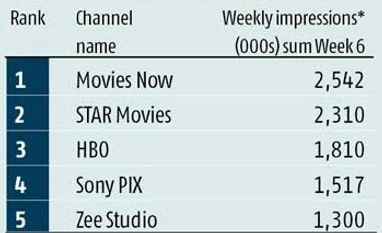
"In the feedback we got from viewers, we realised that the way the channel and its logo looked has a more universal/global appeal almost bordering on noir (a classic genre associated with dark drama and crime)," he says. The channel felt that Indian audiences do not really like the noir genre, those who do are a small bunch, and HBO was losing out on account of the misconceived association. "The perception was that the channel was niche. In India, colours catch the eye and help recall. So we went from the monochromatic packaging to one using red and blue," says Bhandari. The channel changed its look on-air during the premier of 2015's blockbuster starring Charlize Theron and Tom Hardy, Mad Max: Fury Road. And it seems to be working as HBO is now third among the top five most watched English movie channels in the country according to BARC (Broadcast Audience Research Council of India).
In a way BARC has been a big game changer for the industry. Although its inclusion of rural data is yet to impact the English entertainment and movie players since the TG for these channels lies ex-rural, it has forced a relook at viewership stereotypes in the industry. Bhandari concedes that the introduction of BARC data has changed the dynamics of the game, but he believes that the agency still needs some time to stabilise its data collection and assimilation process. The way he sees it, this is the time that the channel has at its disposal to get its packaging and content in sync with the TG's needs.
Bhandari says that they are also putting together a new library. The next step will be to acquire 'massier' content (mainly in the action and comedy genre), and the new slate of movies will be released on-air next calendar. HBO already has the library from Paramount and Warner Bros which is currently playing on air and it will look at getting more studios on board.
Is HBO is going against the tide by assuming a mass strategy at a time when channels are choosing to go niche? Bhandari believes the content should reflect the expectations of the audience. However, he says that HBO will continue to air some of the offbeat films that it does currently; the only change will be that the prime time bands will be taken by 'massy' titles.
On paper, the plan seems to be ticking all the boxes but there are several challenges ahead especially because HBO in India leads a dichotomous existence. The HBO movie channel is run by Turner International which handles the distribution and operational aspects. Bhandari is responsible for running HBO and Turner's Warner Bros channel which also airs Hollywood films. But HBO Inc has an exclusive content licensing arrangement with Star India for its shows (
Game of Thrones and
Vinyl now showing on Star World and Star Premiere HD are HBO shows). Not only will the brand team need to create a strong association between HBO the movie channel and Indian audiences, it will also have to carve an identity that is distinct and allows the channel to disdistance itself from the shows playing on a rival screen.

 "HBO moves from niche to mass")


 Connect with us on WhatsApp