What does a large consumer goods company do when it wants to increase the number of active accounts in a small city? It gets a business school student to help devise a new daily activity map and salary structure for the sales force.
The project to increase active accounts and direct coverage for Colgate-Palmolive in Nagpur by Ankur Surolia, an XLRI-Jamshedpur student, won the first prize at the Business Standard Best B-School Project Awards, 2013, presented in Mumbai on Wednesday.
Across all award-winning projects, innovation was the key theme. During his internship project with the fast-moving consumer goods company, Surolia had designed a new methodology for the sales force to reach out to customers, through effective utilisation of the city route map. Further, he proposed a new salary structure for the sales force, so that it would be motivated to give its best. “With a tricky distribution setting such as Nagpur, the project helped the firm increase overall retail presence and add new stores in the city,” said Surolia.
First runner-up Ankit Gupta from Indian Institute of Management, Raipur, devised a mechanism to optimise geo-location mapping for Cafe Coffee Day (CCD). He created an internet strategy (through Facebook and Google Maps) for customers to better identify a CCD outlet near their location in Bangalore. He pointed to the need for dynamic locator pages for CCD outlets.
Vishal A Patil from Symbiosis Institute of International Business, Pune, secured the third prize for his project on material variance reduction for PPG Asian Paints operations at the Patancheru plant in Hyderabad.
The process of selecting the award winners was rigorous. All 157 entries were evaluated by Deloitte Touche Tohmatsu, which reduced the number to 16. Subsequently, a six-member external jury, headed by Ajit Balakrishnan, founder and chairman and managing director, Rediff.com, assessed the projects in two stages. In the first, held in early December, the number of shortlisted projects was reduced to five. In the final phase, the five finalists made presentations on their projects, following which the jury decided on the winners.
Apart from Balakrishnan, the jury comprised Ravi Kant, vice-chairman, Tata Motors; M G Parameswaran, executive director, FCB Ulka; R Suresh, MD, RGF Executive Search; Ambar Chowdhury, senior director, Deloitte Touche Tohmatsu India; and Sanjay Jorapur, executive vice-president and global head (human resources), Crompton Greaves.
Speaking at the function, Balakrishnan said he was impressed by the wide range of projects. “On one side, we saw deep quantitative methodologies and analysis; on the other, there was use of social media and applications for solving problems.”
Kant said, “We are going through uncertain times. The key is to remain innovative in this competitive environment. Apart from this, people skills are crucial.” Chowdhury said today’s business students were tomorrow’s business leaders. Therefore, there was a need to transfer academic skills into business situations.
Vatsal Jain and Kalyan Bhaskar from IIM-Ahmedabad won the second consolation prize for a social business model of electronic waste management in India. Lavina Mittal from Xavier Institute of Management, Bhubaneswar, won the first consolation prize for her project on helping Mahindra Retail develop a new version of an ‘own-your-customer’ model to increase customer stickiness.
WINNING PROJECTS Winner: To improve the effective retail coverage and numeric distribution of Colgate- Palmolive in Nagpur city
ANKUR SUROLIA
XLRI, Jamshedpur
Problem: To increase the active accounts and direct coverage in Nagpur city by identifying and adding new stores and by optimising call value. Nagpur lags behind compared to other metro cities of Maharashtra in terms of overall and effective retail coverage.
Solution: There was an Individual store mapping with respective sales managers followed by pair- wise interaction for paired routes. Then he prepared a final plan with 39 weekly and 37 fortnightly beats and new sales managers salary structure. The new salary structure will have areas like call productivity as added parameters. Now, 164 stores can be covered within the existing beat plan, whereas two new sales managers will be required to cover the remaining 375 stores.
First runner-up: Optimising geo- location mapping for Cafe Coffee Day
ANKIT GUPTA
Indian Institute of Management, Raipur
Problem: The problem was to make use of geo- mapping for Cafe Coffee Day (CCD) outlets in Bangalore city. While peers had complete address and reviews, several CCD stores did not have store information on the internet.
Solution: Develop Google Place Page for each store and also develop separate Facebook page for each store. Further, have people on smartphones directly using application to search stores. There was also suggestions for feedback and review aggregators. This leads to complete information coming up on search engines when a store was searched.
Second runner-up: Material variance reduction for PPG Asian Paints operations
VISHAL A PATIL
Symbiosis Institute of International Business, Pune Problem: To study material handling and material accounting practices at Asian Paints, to understand the inherent reasons for material variance and to provide comprehensive solutions and a monitoring mechanism for minimising this.
Solution: Identified traceability as a major issue and modified storage layout for improved monitoring. Also identified sticking losses and declaration errors and created datasheets for shortlisted material. He also did an A- B- C analysis, considering storage, production and financial requirements. Identified major contributors and reasons for variance generations. A cycle count mechanism was also developed, with necessary work instruction and monitoring mechanism.

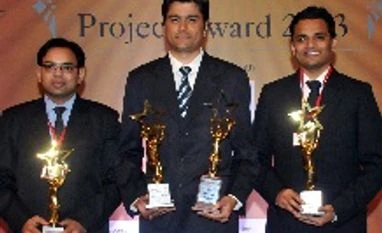 "Innovation the key to top honours")


 Connect with us on WhatsApp