As Scoot steps into new destinations and increases the frequency of its current schedules, its parent Singapore Airlines (SIA) is shoring up its strategy for the four brands it plies in India. Keen to tap into the growing desire of Indians to fly abroad, especially in non-metros, SIA is using its no-frills (Scoot and Tigerair) and premium carriers (Singapore Airlines and Silkair) to reach out to fliers in the low to premium segments with an identity that merges seamlessly across its brands.
BUDGET FLYING A number of international airlines have their no-frills brands catering to Indian fliers, flying out of multiple cities in India to different destinations
AIR ARABIA – to Sharjah
Air Asia (and AirAsia X) – to Kuala Lumpur
Fly Dubai –to Dubai
Tigerair (SIA) – to Singapore
Scoot (SIA) – to Singapore and beyond
Scoot is aiming for the budget platform, currently being served by a number of domestic and international carriers. In doing so, Scoot hopes to leverage SIA's long-standing association with India and the strong recall the brand has among fliers across categories. And at the same time it is giving wing to its parent's ambitions to be the largest international airline across segments, in India.
The last in a chain of four brands that SIA introduced in the country, Scoot currently flies Singapore-Chennai and Singapore-Amritsar and plans to add Jaipur to the list by October this year. It is a low-cost, medium-to-long haul carrier. Leslie Thng, chief commercial officer of Scoot and Tigerair, the two budget offerings from SIA, says that India is one of the fastest growing aviation markets in the world.
The Indian aviation market grew by 27 per cent in 2016 over the previous year, making it the fastest growing market in the world, according to the passenger traffic data released by the International Air Transport Association (IATA). With Scoot SIA will be present in all four spaces including premium (Singapore Airlines), full service (Silk Air), low cost (Tiger Airways) and low cost-cum-medium and long haul (Scoot). It is also a partner with the Tata group in Vistara.
What drives SIA to fly so many brands? The strategy is to penetrate the market and widen the base at the same time. SIA is using Silkair and Tigerair, which have smaller aircraft, to penetrate and grow the market. Having developed the market, it secures the relationship by flying in larger aircraft from Singapore Airlines and Scoot.
A new holding company, Budget Aviation Holdings, is looking at ways to maximise the synergy between Tigerair and Scoot. But the brands will continue to operate as separate identities for the time being. Scoot took over operations from Tigerair for its Singapore-Chennai route. Tigerair is for passengers travelling to Singapore while Scoot targets passengers going beyond, to Australia, Taipei, Korea and Japan. Scoot is aiming at 80-85 per cent occupancy in its Indian operations over a period of time. Almost 60 per cent of the total airlines market in South East Asia is low cost carrier market, the company says.
However, many budget airlines have crashed to the ground in India, despite the best marketing plans and the biggest advertising budgets. Competitors such as AirAsia X and Jetstar Asia have been badly bruised, indicating that the ride is not going to be smooth. Thng believes that Scoot will score on quality of flying experience. Besides, he says the airline's operating costs are lower due to the fuel efficiency of Boeing 787 Dreamliner aircrafts. Scoot, he claims, will run up expenses at least 15-40 per cent lower than traditional airlines.
Interestingly, for a budget airline, Scoot is banking on the quality of its service. Thng says that his airline will offer far more choices to the flier than any of the others. "We offer comfort, better pricing and our values are attractive," said Thng, who is targeting both leisure and corporate travellers.
Analysts believe that Scoot will rely heavily on transit traffic to fill up its new flights from India. The company will be looking at tier II cities in the country for expansion and it would look at a pan India presence over a period of time, says Bharath Mahadevan, country head (India), Scoot.
The airline expects 50-80 per cent of passengers from India to fly onwards on its network in Southeast Asia and Australia. Also, it will tap into the demand for cargo transfers and Scoot can carry 10-12 tonnes daily on each flight. It is also banking on cross-selling opportunities with Singapore Airlines.
However, the big challenge for the brand will be dealing with customer expectations. Since Scoot is relying heavily on SIA's brand pull, it will have to contend with customers expecting a similar service even when flying on a budget. Thng says that the airline will focus on educating consumers travelling on a full service carrier and then hopping on to a low-cost connecting flight. There will be some product differences; there will be some things low cost carriers will not do. But, he says, "We are hopeful that cross selling among the four airlines will work."
Scoot currently has 11 aircraft and will be adding another nine 787 Dreamliners to its fleet. "In the future we want to operate daily service to the destinations we are operating," says Thng.

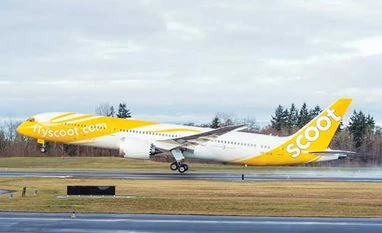 "Scoot spreads its wings")


 Connect with us on WhatsApp