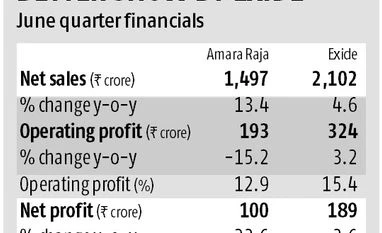
Operating profit margin at 12.9 per cent, down 430 basis points (bps) over the year-before quarter, was the lowest in the past nine quarters.
The company said these were due to high pricing pressure in the industrial segment and lower operating profit margin in the home uninterrupted power system (UPS) segment (seven to eight per cent). On top of a weaker pricing environment and adverse product mix was the 400 bps year-on-year rise in raw material costs as a percentage of sales, to 70 per cent.
While peer Exide also saw raw material pressure and employee cost increase, its margin fall was restricted to 20 bps, to 15.4 per cent, ahead of analyst estimates of under 15 per cent. Lower other expenses helped. Exide is undertaking cost control and technology upgrade.
For Amara Raja, a poor margin show, higher tax rate and depreciation expense led to a 24 per cent year-on-year fall in net profit to Rs 100 crore.
Exide also had higher tax rates and lower other income in the quarter. Its net profit at Rs 89 crore was down to four per cent more, year-on-year.
On most parameters, Exide was ahead of Amara Raja in the quarter. However, the latter had better revenue growth. Exide’s was 4.6 per cent higher over a year; Amara Raja’s at 13.4 per cent beat estimates, driven by higher home UPS and replacement segment sales.
Both companies had taken price hikes over the earlier two quarters by 10-15 per cent, to offset the increase in higher raw material costs in the replacement segment. They might have to do so again, as lead costs in July were up 18 per cent annually and five per cent over the June quarter.
On the demand side, growth would be led by improved demand from the automotive segment, as well as market share from the unorganised sector with implementation of the goods and services tax.
Tighter tax compliance will lead to a gradual opening of the replacement battery market for the commercial vehicles and tractor segment, where the unorganised sector has more than half.
While existing product lines will continue to face competitive and pricing pressure, both companies would look at newer business segments such as e-rickshaws.
Analysts at Emkay Global believe Exide’s renewed strategy, technology upgrade and better after-sales service will lead to lowering of the valuation gap between with Amara Raja. Exide trades at about 22 times the FY18 earnings estimate; Amara Raja’s valuations are pegged at 28 times.
One subscription. Two world-class reads.
Already subscribed? Log in
Subscribe to read the full story →
Smart Quarterly
₹900
3 Months
₹300/Month
Smart Essential
₹2,700
1 Year
₹225/Month
Super Saver
₹3,900
2 Years
₹162/Month
Renews automatically, cancel anytime
Here’s what’s included in our digital subscription plans
Exclusive premium stories online
Over 30 premium stories daily, handpicked by our editors


Complimentary Access to The New York Times
News, Games, Cooking, Audio, Wirecutter & The Athletic
Business Standard Epaper
Digital replica of our daily newspaper — with options to read, save, and share


Curated Newsletters
Insights on markets, finance, politics, tech, and more delivered to your inbox
Market Analysis & Investment Insights
In-depth market analysis & insights with access to The Smart Investor


Archives
Repository of articles and publications dating back to 1997
Ad-free Reading
Uninterrupted reading experience with no advertisements


Seamless Access Across All Devices
Access Business Standard across devices — mobile, tablet, or PC, via web or app
)