Bank shares fall on farm loan waiver in Maharashtra

Impact of the loan waivers will be felt more on public sector banks than their private sector peers
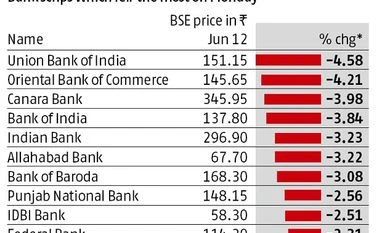
graph
graph
Ashley Coutinho Mumbai
Last Updated : Jun 13 2017 | 12:51 AM IST
Shares of banks fell up to four per cent on Monday after the Maharashtra government decided to waive off farms loans of small and marginal farmers.

Union Bank of India and Oriental Bank of Commerce were the top losers, slipping 4.5 per cent and 4.2 per cent, respectively. Canara Bank, Bank of India, Indian Bank, Allahabad Bank and Bank of Baroda were the other major losers, losing anywhere between 3.1 per cent and 3.9 per cent. The Nifty Bank index fell about one per cent to 23,470. The impact of the loan waivers will be felt more on public sector banks (PSBs) than their private sector peers.

According to a note by Kotak Institutional Equities, Maharashtra has nearly Rs 4.2 lakh crore of agriculture loans (comprising 23 per cent of loans) and Rs 1.2 lakh farm loans (seven per cent of loans) with PSBs holding nearly 52 per cent of total farm loans, followed by cooperative banks (32 per cent) and private banks (12 per cent).

On Monday, Finance Minister Arun Jaitley met PSB chiefs to take stock of their finances. He said the government was working towards consolidation of state-owned banks and the Reserve Bank of India was also in the process of preparing a list of bad loans where resolution is required under the insolvency and bankruptcy rule.

The Maharashtra government has reportedly waived off loans of small and marginal farmers with immediate effect, with these farmers being eligible for fresh loans despite being blacklisted earlier due to the overdue status of their loans.

“Frequent farm waivers create expectations of future waivers and can be serious disincentive to delay or stop loan repayments. Greater share of PSU banks in farm credit, which are considered quasi-government, increases the risk of moral hazard,” observed the Kotak report. 

“Lower product profitability due to higher delinquencies can lead to higher interest rates or reduction in credit availability. This has obvious risk of greater reliance on unorganised sources for incremental credit needs,” it said.

Earlier this year, the Yogi Adityanth-led government in Uttar Pradesh had announced it would write off farm loans to the tune of over Rs 30,000 crore.

The loan waiver comes in the wake of banks' growing non-performing assets (NPAs) and under-capitalisation woes. McKinsey estimates the entire banking system will need capital to the tune of Rs 1.85-2.75 lakh crore till FY22 to manage their business.


One subscription. Two world-class reads.

Already subscribed? Log in

Subscribe to read the full story →
*Subscribe to Business Standard digital and get complimentary access to The New York Times

Smart Quarterly

₹900

3 Months

₹300/Month

SAVE 25%

Smart Essential

₹2,700

1 Year

₹225/Month

SAVE 46%
*Complimentary New York Times access for the 2nd year will be given after 12 months

Super Saver

₹3,900

2 Years

₹162/Month

Subscribe

Renews automatically, cancel anytime

Here’s what’s included in our digital subscription plans

Exclusive premium stories online

  • Over 30 premium stories daily, handpicked by our editors

Complimentary Access to The New York Times

  • News, Games, Cooking, Audio, Wirecutter & The Athletic

Business Standard Epaper

  • Digital replica of our daily newspaper — with options to read, save, and share

Curated Newsletters

  • Insights on markets, finance, politics, tech, and more delivered to your inbox

Market Analysis & Investment Insights

  • In-depth market analysis & insights with access to The Smart Investor

Archives

  • Repository of articles and publications dating back to 1997

Ad-free Reading

  • Uninterrupted reading experience with no advertisements

Seamless Access Across All Devices

  • Access Business Standard across devices — mobile, tablet, or PC, via web or app

Next Story



