Debt MFs prune exposure to G-secs

Debt-fund managers have drastically cut allocation to G-secs over the past six months
Table
Table
Chandan Kishore Kant Mumbai
Last Updated : May 26 2017 | 2:19 AM IST
Debt-fund managers have drastically cut allocation to government securities (G-secs) over the past six months.

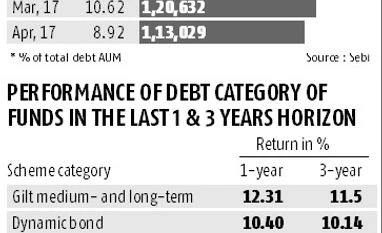
At the end of April, debt-mutual funds (MFs) held government paper worth Rs 1.13 lakh crore, 8.9 per cent of debt assets under management (AUM).

Six months ago, debt MFs’ G-secs holding stood at Rs 1.62 lakh crore — nearly 14 per cent of debt AUM.

The pruning of exposure to G-secs owes itself to the belief that the interest rate cutting cycle by the Reserve Bank of India (RBI) is nearing an end. 

Fund managers are increasing their exposure to corporate paper. They are also looking at accrual strategies with the aim of matching the double-digit returns made in the past few years. Under this, a fund manager bets on companies whose credit ratings are expected to improve. 

“Fund managers have reduced exposure to G-secs as the RBI has changed its stance from accommodative to neutral. It also flagged upside risk to inflation and narrowed the monetary policy corridor to 25 basis points. With a heavy supply of G-secs and the central bank expected to keep rates on hold, fund managers have decided to cut exposure to G-secs and make higher investments in corporate bonds,” said Parijat Agarwal, head of fixed income at Union Mutual Fund.

Reducing exposure to G-secs seems to have worked. The yield on the benchmark 10-year G-sec has hardened from 6.2 per cent in November to 6.9 per cent in April.

Since bond prices vary inversely as the yield, an increase in yields means a fall in bond prices.

Pankaj Pathak, senior manager (fixed income) at Quantum Mutual Fund, said: “We are at the end of the rate cut cycle. Amid this, there is a shift from duration funds to accruals, and exposure to short-term good quality corporate debt papers is on the rise. This is mainly to get some higher yields.”

The past few years have been good for debt MF schemes. Funds in fixed income, credit opportunities, dynamic bonds, and medium- and long-term gilt funds have given double-digit returns to investors in the past one to three years.

While fund managers are increasing exposure to corporate bonds, they are taking a cautious approach by sticking to high-quality paper, given the risky credit environment.

“Besides following credit rating agencies, we also do internal research. Moreover, we prefer structured credit paper, where chances of recovery exist. Also, most schemes try to diversify their holdings to ensure that there is minimal impact on the price of the units if there is a default,” said the chief investment officer (fixed income) of a large fund house.

Debt AUM, at nearly 70 per cent of the assets of the more than Rs 19 lakh crore mutual fund industry, is a major contributor to the size of the sector. In recent years, retail investors too have started opting for debt funds with expectations of 2-3 per cent more returns than banks’ deposits would offer via systematic investment monthly plans and lump sum investments.

One subscription. Two world-class reads.

Already subscribed? Log in

Subscribe to read the full story →
*Subscribe to Business Standard digital and get complimentary access to The New York Times

Smart Quarterly

₹900

3 Months

₹300/Month

SAVE 25%

Smart Essential

₹2,700

1 Year

₹225/Month

SAVE 46%
*Complimentary New York Times access for the 2nd year will be given after 12 months

Super Saver

₹3,900

2 Years

₹162/Month

Subscribe

Renews automatically, cancel anytime

Here’s what’s included in our digital subscription plans

Exclusive premium stories online

  • Over 30 premium stories daily, handpicked by our editors

Complimentary Access to The New York Times

  • News, Games, Cooking, Audio, Wirecutter & The Athletic

Business Standard Epaper

  • Digital replica of our daily newspaper — with options to read, save, and share

Curated Newsletters

  • Insights on markets, finance, politics, tech, and more delivered to your inbox

Market Analysis & Investment Insights

  • In-depth market analysis & insights with access to The Smart Investor

Archives

  • Repository of articles and publications dating back to 1997

Ad-free Reading

  • Uninterrupted reading experience with no advertisements

Seamless Access Across All Devices

  • Access Business Standard across devices — mobile, tablet, or PC, via web or app

Next Story



