Associate Sponsors

Domestic retail investors take 30% hit as equity markets decline

About 70% of the loss since August 2018 due to high weightage in mid- and small-cap shares
Domestic retail investors take 30% hit as equity markets decline
Krishna Kant Mumbai
Last Updated : Mar 04 2019 | 1:20 AM IST
The recent downturn in equity markets has hit retail investors in a big way but the benchmark equity indices understate the losses suffered by them. The Nifty50 index is down only 7.5 per cent from its August 2018 all-time high but retail investors — those with investments of Rs 2 lakh or less in a company — have lost nearly 30 per cent of the gains they made in the mid- and small-cap rally of the previous two and half years. 

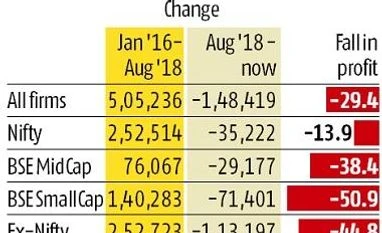
The value of the total retail equity portfolio is now worth Rs 11.1 trillion, down from Rs 12.6 trillion at the end of August 2018. Excluding their exposure to the Nifty50, the market value of the retail portfolio is down 45 per cent from the peak. 

Analysts attribute the disproportionate losses suffered by retail portfolios to a much sharper fall in mid and small-cap space, compared to benchmark indices that comprise large-cap stocks. 

“Domestic retail investors largely invest in mid- and small-cap stocks, which have borne the brunt of the downturn on the Dalal Street,” said G Chokkalingam, founder and managing director, Equinomics Research & Advisory Services.

In all, the market value of retail investors’ equity portfolio is down Rs 1.48 trillion from the high in August 2018, with nearly three-fourth of the losses coming from their investments in stocks outside of Nifty50 index. About 68 per cent of the losses in retail portfolios is due to the fall in mid- and small-cap stocks. In comparison, retail investors made capital gains of around Rs 5 trillion from January 2016 and August 2018.

The analysis is based on the shareholding pattern of retail investors and market capitalisation of a constant sample of 955 companies that are part of BSE 500, BSE MidCap and BSE SmallCap indices. The market capitalisation data is for end of January 2016, August 2018 and February 27, 2018, while the shareholding pattern is the preceding quarter in each period.

There are 4,100 stocks available for trading on BSE, and analysts said cuts have been even sharper for smaller stocks that are not part of any index.  

Chokkalingam estimated a decline of Rs 24 trillion in the total market capitalisation of listed companies excluding top-15 outperforming index stocks from the peak, which has hit retail investors and high-net worth individuals.

On average, the market capitalisation of stocks that are part of BSE SmallCap index is down around 25 per cent since August last year against 8 per cent decline in the combined market capitalisation of index stocks.

In all, 69 mid and small stocks in our sample have lost 50 per cent or more of their value since August 2018, while another 257 non-index stocks (28 per cent of all) are down between 30 per cent and 50 per cent during the period. 

This has translated in big losses for domestic retail investors, which are the largest non-promoter investors in small-caps stocks. Retail investors have lost nearly 51 per cent of all their upside in BSE SmallCap index and 38 per cent of the gains in BSE MidCap index since August 2018. Retail investors’ total loss in these two indices is pegged at Rs 1.1 trillion during the period.

At the end of December, retail investors owned 14.4 per cent of BSE SmallCap index stocks next only to promoters’ stake of 55 per cent on average. In comparison, retail investors owned 9.3 per cent of BSE MidCap index stocks and 7.6 per cent of Nifty50 index stocks on average at the end of December.

Foreign institutional investors are the second-largest non-promoter owner of Nifty50 and BSE MidCap stocks followed by mutual funds.

One subscription. Two world-class reads.

Already subscribed? Log in

Subscribe to read the full story →
*Subscribe to Business Standard digital and get complimentary access to The New York Times

Smart Quarterly

₹900

3 Months

₹300/Month

SAVE 25%

Smart Essential

₹2,700

1 Year

₹225/Month

SAVE 46%
*Complimentary New York Times access for the 2nd year will be given after 12 months

Super Saver

₹3,900

2 Years

₹162/Month

Subscribe

Renews automatically, cancel anytime

Here’s what’s included in our digital subscription plans

Exclusive premium stories online

  • Over 30 premium stories daily, handpicked by our editors

Complimentary Access to The New York Times

  • News, Games, Cooking, Audio, Wirecutter & The Athletic

Business Standard Epaper

  • Digital replica of our daily newspaper — with options to read, save, and share

Curated Newsletters

  • Insights on markets, finance, politics, tech, and more delivered to your inbox

Market Analysis & Investment Insights

  • In-depth market analysis & insights with access to The Smart Investor

Archives

  • Repository of articles and publications dating back to 1997

Ad-free Reading

  • Uninterrupted reading experience with no advertisements

Seamless Access Across All Devices

  • Access Business Standard across devices — mobile, tablet, or PC, via web or app

Next Story



