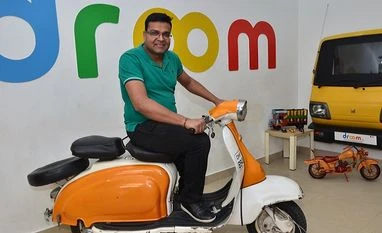
Droom Technologies, an online marketplace for used and new cars, two-wheelers and commercial vehicles, is looking to go public and list on the Nasdaq by 2020. By that time it hopes to increase its annual gross revenue to Rs 200 billion from the current Rs 55 billion, the company’s founder and chief executive officer Sandeep Aggarwal told Business Standard.
The online marketplace Droom, which counts Lightbox, Japanese e-commerce firm Beenos and Digital Garage as its existing investors, has had six rounds of fundraising since it was founded in 2015. It is also in the process of expanding operations to several Southeast Asian countries including Malaysia, Thailand, the Philippines and Singapore and expects markets outside India to account for 5 to 7 per cent of its revenue by end of next year. It has raised $125 million so far, including the recently closed Series-E funding to raise $30 million.
“We have been growing at a very fast pace and expect the momentum to continue. We are close to being a Unicorn,” said Aggarwal pointing that with less than 1 per cent sales of pre-owned vehicles taking place online, there is a huge untapped potential. With a presence in 700 cities in India, he sees the next wave of growth for his company coming from regions beyond the top 100.
Aggarwal claimed his firm has cornered 75 per cent share of online automobile market in India.
Droom is among the several e-commerce firms that are betting big on the pre-owned vehicles as a category in one of the fastest growing auto markets of the world.
Highlights
— Droom to list on Nasdaq by 2020
— Eyes quadrupling of revenues to Rs 200 billion by then
— To expand to Asean markets
— Growth in India to be fuelled by cities other than top 100
Spawned from the boom in the smartphones, high internet penetration and a relatively lower car penetration, companies such as Droom and several others including Cartrade, Truebil, Cars24, are looking for a pie in a segment that has been advancing at a brisk pace year-on-year. These firms are seeking to organise a largely unorganised space through technology and data science to address the so-called information asymmetry.
Considering that the ratio of used cars to new ones in India remains very low – one used car on every new one, as compared to mature markets like the US, where it is 1:5, “There is a huge upside,” said Kumar Kandaswami, a partner at Deloitte Touche Tohmatsu India. The segment, according to him will benefit further when the new emission norms kick in 2020. Among other things, it will make small cars pricier and prompt buyers look for pre-owned cars, he said.
Aggarwal claims that while there were several internet-based firms in the market prior to its entry, but most of them are content-driven lead generation platform and none offered an end-to-end transaction services the way Droom did, if someone was looking for a pre-owned vehicle. “We now have 715,000 active listing, which is worth Rs 500 billion. We get 35 million monthly visitors on our site,” he said adding that seeing an opportunity in adjacent businesses, his firm has recently into and created strategic business verticals for insurance, and registration of pre-owned vehicles.
Deloitte’s Kandaswami says “Its early days to predict about the long-term sustainability and profitability of the e-commerce firms in the segment but as things stand today, given the nascent phase of the market getting organised, “there is room for everyone to co-exist.” Considering that most of these companies are now looking to tap into towns and cities beyond top 100, a combination of physical and digital presence will work the best as many of these smaller cities will not have internet.