F&O stock list balloons as market rallies

Number of stocks for derivatives rises 50% in three years
graph
graph
Samie Modak
Last Updated : Apr 21 2017 | 1:13 PM IST
The list of stocks available for trading in futures and options (F&O) on National Stock Exchange (NSE) has swelled by 50 per cent in three years. 

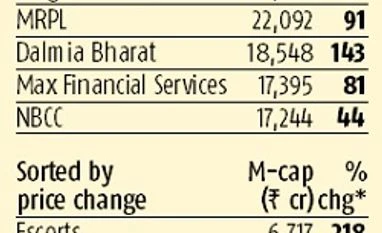
With the addition of 15 securities from April series and 16 from May series, investors and traders can take derivatives positions in 205 stocks. By comparison, only 136 stocks were part of F&O segment in 2014. 

Market players say a rally after December demonetisation lows has helped a lot of stocks meet criteria to enter F&O segment. The NSE CNX Midcap and Smallcap indices have rallied 30 per cent and 34 per cent, respectively, since December 26, 2016. Several of their components have gained more than 50 per cent each. 

Derivatives experts say new stocks entering F&O is a sign of a bull market. In 2007, peak of bull run, there were 230 stocks in derivatives.

"Addition of stocks to F&O is a positive as it gives investors opportunity to hedge. However, one has to be careful, particularly in counters not very liquid. Often, the open interest in these stocks is concentrated in the hands of few, who could manipulate the price," says Hemant Nahata, senior derivatives analyst at IIFL Wealth Management.

Bajaj Finserv, Shree Cement, Nestlé, Infibeam Incorporation, Balkrishna Industries, and Can Fin Homes are among the latest additions to F&O segment.

"Most of the stocks that have got added have seen a rise in investor interest over the past few months. Therefore, it is a good opportunity for traders and investors. They can take positions in these counters with a relatively low margin. Addition to F&O is also good for price discovery, given the ease of building positions both on short and long sides. Trading opportunities will also go up with addition of more stocks," says Sacchitanand Uttekar, assistant vice-president (Research & Data Analysis), Tradebulls .

Stocks in F&O are chosen from among the top 500 companies in terms of market capitalisation and trading volumes in the previous six months. Also, the order size required to cause stock price change is also an important criterion.

The availability of liquidity has helped stocks meet this price-change criterion. 

Experts say if market sentiment turns negative, some of the new stocks could turn highly volatile, as there are no circuit filters on stocks once they are part of the derivatives segment.

"It takes a little time for the markets to mature. As more stocks are getting added in such a short time span, there could be some pricing mismatch. Also, if markets turn volatile, the new stocks could see wild price fluctuations," says Nahata.

One subscription. Two world-class reads.

Already subscribed? Log in

Subscribe to read the full story →
*Subscribe to Business Standard digital and get complimentary access to The New York Times

Smart Quarterly

₹900

3 Months

₹300/Month

SAVE 25%

Smart Essential

₹2,700

1 Year

₹225/Month

SAVE 46%
*Complimentary New York Times access for the 2nd year will be given after 12 months

Super Saver

₹3,900

2 Years

₹162/Month

Subscribe

Renews automatically, cancel anytime

Here’s what’s included in our digital subscription plans

Exclusive premium stories online

  • Over 30 premium stories daily, handpicked by our editors

Complimentary Access to The New York Times

  • News, Games, Cooking, Audio, Wirecutter & The Athletic

Business Standard Epaper

  • Digital replica of our daily newspaper — with options to read, save, and share

Curated Newsletters

  • Insights on markets, finance, politics, tech, and more delivered to your inbox

Market Analysis & Investment Insights

  • In-depth market analysis & insights with access to The Smart Investor

Archives

  • Repository of articles and publications dating back to 1997

Ad-free Reading

  • Uninterrupted reading experience with no advertisements

Seamless Access Across All Devices

  • Access Business Standard across devices — mobile, tablet, or PC, via web or app

Next Story



