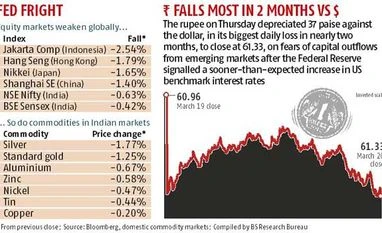
Over the past year, Dalal Street has reacted with panic to all US Federal Reserve comments on monetary tightening. But when American central bank chief Janet Yellen on Wednesday signalled rate increases from 2015, the response in India was measured. Though stocks and the rupee fell on Thursday, the weakness was much less than that after the Fed’s hint last year of a rollback of its monthly bond-buying programme, also known as quantitative easing (QE).
So, what has changed from last year? Besides some narrowing in the country’s current account deficit (CAD) and a relative stability in the rupee’s value against the dollar, there has been a shift in focus to the coming general elections. And, the market is betting highly on the Bharatiya Janata Party, led by Narendra Modi, coming to power after May.
That the spotlight is on elections, and not on QE tapering, is also reflected in foreign institutional investors’ (FIIs’) investment on Thursday. A day after Yellen’s hawkish comments on rates, these investors pumped Rs 722 crore into Indian stocks, helping benchmark indices restrict losses from their previous close to 0.4 per cent. Analysts do not expect this gush of FII money to recede soon, in spite of QE tapering, as investors are optimistic about the BJP, widely seen as pro-industry, forming the next government and announcing measures to revive the economy
“FII flows will continue, no matter what,” said Rakesh Arora, managing director & head of research (India), Macquarie Capital Securities. “Once the elections are over, the focus for the markets will be the pace of economic recovery and the policies put in place by the new government.”
This optimism seen now is in stark contrast with the situation in December, when markets were fearing a QE tapering from the Fed (which started on January 1) would restrict FII inflows and put a lid on gains. This was partly driven by the belief that the dollar would strengthen against the rupee on account of the tightening.
A weakening rupee has an impact on flows, as it erodes the value of FIIs’ Indian holdings. However, the pessimism has now receded, with the rupee’s recent strength following a sharp narrowing of trade deficit, appointment of Raghuram Rajan as Reserve Bank of India governor and restrictions on gold imports.
According to analysts, even after the election euphoria wears out and investors start evaluating ground realities, India will be in a better position to withstand the impact of less liquidity than many other emerging markets (EMs).
“As tapering progresses, we will see an increasing degree of investor discrimination within EMs, based on performance of the respective currencies of these countries, reform efforts and domestic macros. Within EMs, India stands out on many of these criteria. Its economic growth has bottomed, currency has stabilised and the current account deficit has been brought under control,” said Abhay Laijawala, managing director & head of research, Deutsche Equities India.
In 2014, FIIs have so far invested about Rs 11,400 crore in Indian equities. These investors have remained net-buyers (to the tune of about Rs 13,500 crore) in 23 of the past 24 trading days. “For FIIs, the stability in the rupee has been the biggest driver of confidence so far,” said Laijawala.
Fed’s bond-buying programme, which was on Wednesday lowered by another $10 billion to $55 billion a month, would be wound down by the end of the year and a rate increase would be effected in six months after that, Yellen indicated.
“Because interest rates are going up, more funds will be diverted from bonds to equity markets. Part of that money will move into emerging markets like India,” said Macquarie Capital Securities’ Arora.
Some analysts, however, believe investors might be underestimating the real impact of Fed ending its loose monetary policy stance. “Rather than the taper worries, an earlier-than-anticipated normalisation of monetary policy by Fed remain the bigger concern for EMs,” said Deutsche Equities’ Laijawala.

 "For D-Street, it's polls over taper for now")


 Connect with us on WhatsApp