GI tag for basmati to stabilise prices
Industry body to apply in EU, US and Gulf countries for similar recognition
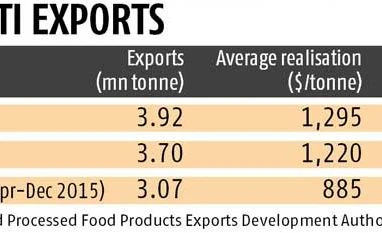
Komal Amit Gera Chandigarh The Geographical Indication (GI) recognition for the basmati rice grown in North Indian states is expected to stabilise the price of basmati and boost exports. Basmati prices had been fluctuating in the global market because of excess supply. With GI tag, supply of spurious varieties of basmati will be restricted. A drastic plunge in the price of basmati in the export market caused distress to the traditional growers and their realisations fell by about 25 per cent.
Basmati rice is grown in Punjab, Haryana, Himachal Pradesh, Uttarakhand, Jammu and Kashmir, and parts of Uttar Pradesh. The states of Punjab and Haryana grow over 70 per cent of Indian basmati. The farm gate price of basmati crashed in kharif 2015 because of oversupply. Prices in Punjab and Haryana touched a rock-bottom and government intervention was sought to lift the crop at minimum support price (MSP) of Rs 1,450 per quintal. The farmers earned between Rs 3,000 and Rs 3,500 per quintal for same varieties of rice in kharif 2014.
Gauging the high returns, cultivation of basmati varieties, which are not agro-climatic zone specific, has gone up in other parts of India in the past few years. An area of about five lakh hectare has been added in non-basmati growing areas creating an artificial glut in the market, sources in Agricultural and Processed Food Products Export Development Authority (Apeda) told Business Standard.
The GI tag for the basmati grown in Indo-Gangetic plains, known for its aroma and length, would protect farmers from sudden price variations. Sources in Apeda confirmed that GI registration has been provided for the area that has been growing basmati for over a hundred years and falls in Indo-Gangetic river basin.
An Apeda official said the supply of basmati has increased 30-40 per cent in the past two years and much of that has been sourced from non-traditional basmati growing areas. Because of the commercial advantage of basmati, new areas in different parts of the country were also brought under this export-oriented premium quality rice, undermining the interests of traditional growers.
The GI tag will also arm Apeda with relevant credentials to challenge the infringement by third parties from various other countries trying to sell deceptive varieties of basmati.
After getting the coveted GI tag at home, Apeda will now apply in EU, USA and Gulf countries, which are major consumers of Indian basmati. “As we already have the certification, it will not take long to get the same in other countries. Earning a GI tag in India implies that the supply chain management is being supervised,” he added.
The official said that Apeda had challenged the attempts of similar certification by non-basmati growing entities in 40 countries to safeguard the interests of the traditional basmati growers.
India has already exported three million tonnes of basmati rice in the current season from April to December 2015 and projects estimated four million tonnes exports by the end of March 2016.
The will have tangible repercussions as the exports earnings on basmati slipped by 25 per cent in 2015-16 over the last year, leading to farmers’ distress in Punjab and Haryana.
Stability in prices as a consequence of GI recognition of basmati will help farmers in maintaining area under basmati and other kharif crops, leading to higher income generation.

 "GI tag for basmati to stabilise prices")


 Connect with us on WhatsApp