Government says El Niño contingency plans ready
Dilip Kumar Jha Mumbai With rising worries about the El Niño climate effect this year, translating to less rainfall in the monsoon season, the Union ministry of agriculture has suggested farmers sow short and medium duration crops.
El Niño is the term for a band of anomalously warm ocean water temperatures that periodically develop off the Pacific coast of South America. This affects weather patterns through the world; one of these is a drier monsoon here.
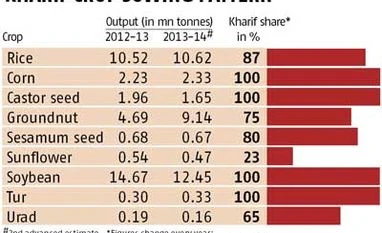
Paddy (rice), maize and soybean are major kharif crops, sown largely in May-June for harvesting in October-November. Commonly, paddy requires at least three or four spells of heavy rainfall; the plant needs knee-deep water logging for good crop germination. A deficiency of rain affects output badly.
“Anticipating less rainfall this monsoon, especially in the northeast region, we are preparing for short-duration varieties of rice and other kharif crops, for which an advisory has already been issued to the Central Research Institute for Dryland Agriculture,” said Jeet Singh Sandhu, agriculture commissioner.
He said contingency plans for less rain were ready. The government has already directed agencies to raise nurseries for rice, have timely placement of inputs, arrangement of seeds and other required inputs, weekly video conferencing for regular liaison and follow-up, mobilising extension staff for field deployment and regular monitoring of crops. There are hybrid and stress-tolerant varieties of paddy seeds from both private and state agencies, which the government tries to promote. These varieties become ready in 60-80 days as compared to 90-120 days of the conventional varieties.
There are also short-duration varieties; one of moong, for instance, can be harvested over 60-65 days as compared to over 90 days for conventional ones. The government says it will also be focusing on seed treatment, weed management and irrigation at critical stages, with additional fund releases.
Skymet, the private weather forecasting agency, has said it estimates a five to 10 per cent deficiency of rain in India this year due to the El Niño effect, the latter resulting in precipitation towards South America and sucking away of moisture from the Bay of Bengal. It adds the distribution of rain across the country will not be uniform; it could be more in some and less in others. Going by the historical evidence, India will witness 90-95 per cent of the average rainfall this year as a whole, says Skymet.
“Indian agriculture is fragile. Farmers generally prepare sowing plans at the time of planting of seeds. An advisory for sowing plans over two months in advance might create a distortion among farmers and hit their annual incomes,” feels Madan Sabnavis, Chief Economist, CARE Ratings.

 "Government says El Niño contingency plans ready")


 Connect with us on WhatsApp