India no longer leader of the pack

D-Street may lose sheen as higher commodity prices eat into margins and forex earners face headwinds

special chart 2
Krishna Kant Mumbai
Last Updated : May 01 2017 | 11:51 PM IST
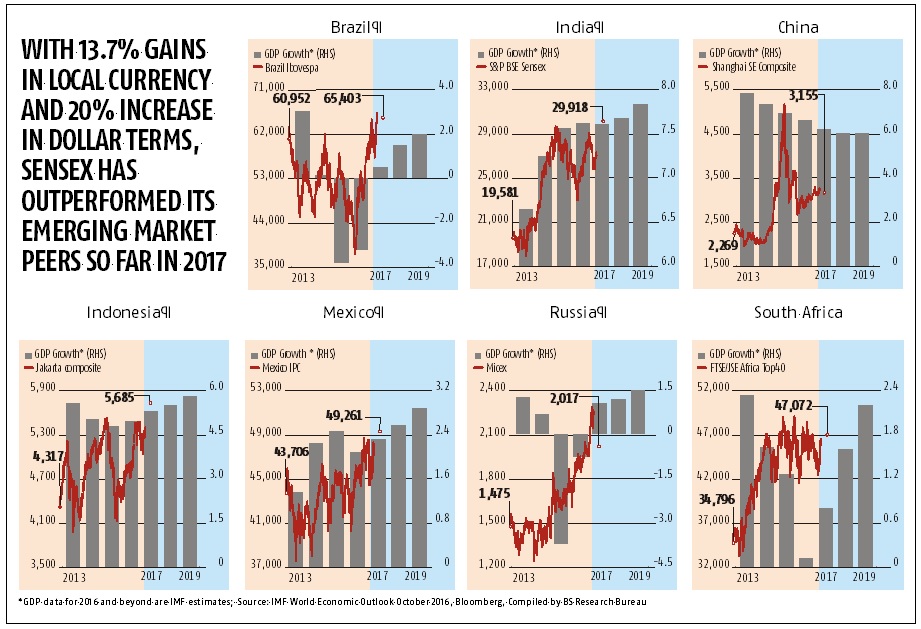
India, the favoured destination of global foreign investors since the 2013 currency crisis, could lose some of the charm to other emerging markets (EMs) in the current global reflation trade. Higher commodity prices will accelerate earnings growth in emerging markets such as Brazil, Russia, South Africa and Indonesia, even as it will hurt corporate India’s margins by way of higher prices of energy and industrial metals. This will make it difficult for Indian markets to preserve their valuation premium over other EMs.
 
The Indian equity market has been on steroids since the 2013 currency crisis. The benchmark BSE Sensex is up nearly 70 per cent since the low of August 2013, when the rupee and equity markets were pushed into a tailspin due to fear of a premature withdrawal of bond purchases by the US Federal Reserve.
 
Since then, the Indian market owes its success to the steady inflow of foreign capital in the past three and a half years, supplemented by incremental investment from domestic investors. Foreign portfolio investors (FPIs) have pumped in nearly $37.5 billion in Indian equity since September 2013 — $850 million (Rs 5,500 crore) a month. India’s debt market received additional inflows of $31.7 billion during the period. Foreign investors loved the stability and higher return on net worth (RoNW) by India at a time when other emerging markets were ravaged by lower commodity prices (see adjoining chart).
 
The same factors that pushed other EMs into a recession — a sharp dip in commodity prices since late 2014 — was a tailwind for India. Unlike other markets, Dalal Street is dominated by consumer companies, including retail lenders and defensives such as information technology (IT) services and pharmaceutical exporters, which offer higher RoNW (or return on equity) and stable earnings. Lower commodity prices, especially crude oil, improved India’s external sector and boosted margins and profitability of Indian manufacturers across the board, despite low single-digit growth in volumes. Foreign investors lapped up the India story.
 
The tide is now turning in the global economy and emerging markets are back in vogue, thanks to a sustained rise in commodity prices. This has meant more investment in emerging markets, including India. Foreign investors have together invested $55 billion in emerging markets equity and bond funds during the first three months of 2017, against $44 billion invested during 2016. India has not been far behind with the country attracting $11.2 worth of inflows during the period.
 
Investors expect the top companies in EMs to post strong earnings growth in the next two years against low single-digit growth of the past three years. India is expected to lead, with the combined net profit of Sensex 30 companies expected to grow by 20.8 per cent in the next 12 months against 0.3 per cent growth in the past 12 months. Markets such as South Africa are likely to do even better, while companies in China and Mexico are likely to match their Indian counterparts.
 
Click on the image to enlarge
However, many analysts have now turned cautious on equity valuation in India. “India remains one of the most expensive markets in the emerging world. In the past, our premium was justified because companies in defensive sectors — IT, pharma and fast moving consumer goods — consistently delivered double digit earnings growth since the 2009 Lehman crisis, turning India into a haven of sorts for investors. Now defensives are showing low single-digit growth and it’s not likely to change for at least two years. This will make it tough for us to justify our valuation premium over others,” says G Chokkalingam, founder & chief executive officer, Equinomics Research & Advisory.
 
IT exporters reported their lowest revenue growth since Lehman crisis, while pharma exports were down three per cent in dollar terms last financial year. IT is India’s biggest export earner and together with pharma, accounts for nearly a third of the earnings of the top listed companies.
 
The benchmark Sensex is currently the fourth most expensive index — when adjusted for underlying return on equity, among the top seven emerging market indices, behind Brazil, Indonesia and China and marginally ahead of South Africa and Mexico.
 
Based on forward earnings, however, Sensex is likely to become the most expensive index by the end of the year, turning risk-reward ratio unfavourable.
 
Some analysts expect another year of consumption-led growth, aided by fiscal stimulus. “I see a mild cyclical uptick in earnings growth in FY18 supported by higher spending by the Union government. This will largely benefit consumer companies and retail lenders,” says Dhananjay Sinha, head of research-institutional equities, Emkay Global Financial Services.
 
However, higher fiscal spending could have consequences for India’s current account deficit and interest rate in the medium to long term if commodity prices remain elevated. Many a times in the past, the combination has landed us in a tight spot.

One subscription. Two world-class reads.

Already subscribed? Log in

Subscribe to read the full story →
*Subscribe to Business Standard digital and get complimentary access to The New York Times

Smart Quarterly

₹900

3 Months

₹300/Month

SAVE 25%

Smart Essential

₹2,700

1 Year

₹225/Month

SAVE 46%
*Complimentary New York Times access for the 2nd year will be given after 12 months

Super Saver

₹3,900

2 Years

₹162/Month

Subscribe

Renews automatically, cancel anytime

Here’s what’s included in our digital subscription plans

Exclusive premium stories online

  • Over 30 premium stories daily, handpicked by our editors

Complimentary Access to The New York Times

  • News, Games, Cooking, Audio, Wirecutter & The Athletic

Business Standard Epaper

  • Digital replica of our daily newspaper — with options to read, save, and share

Curated Newsletters

  • Insights on markets, finance, politics, tech, and more delivered to your inbox

Market Analysis & Investment Insights

  • In-depth market analysis & insights with access to The Smart Investor

Archives

  • Repository of articles and publications dating back to 1997

Ad-free Reading

  • Uninterrupted reading experience with no advertisements

Seamless Access Across All Devices

  • Access Business Standard across devices — mobile, tablet, or PC, via web or app

Next Story