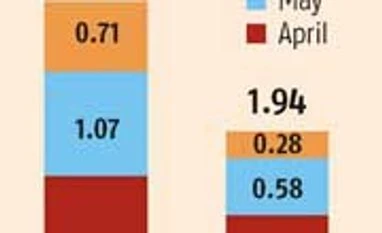
Iron ore exports have shown a whopping 40.5 per cent decline in the first quarter ended June 30 this year at 1.93 million tonnes (mt). During the corresponding quarter last year, exports stood at 3.26 mt. The decline is largely attributed to global slowdown in spot market prices and better prices in the domestic market owing to ban in Odisha, which led to hike in prices.
During April, exports were above one mt and stood at 1.08 mt. Subsequently, in May and June, the exports steadily declined to 0.581 mt and 0.277 mt, respectively, according to data compiled by Delhi-based OreTeam Research. Following the loss of production in Odisha, the exporters preferred to sell their stocks in domestic market and book profits. Overall, the margins shrunk for traders and merchant miners in the export market.
Chinese buyers also stayed away from booking shipments, as the stockpile at their ports went up to 115 mt with good availability of concentrate. The continued differential rate and freight rise charged by the railways discouraged exports during the period.
“One solution, the railways can work on, is to make the rail freight rate for exports and domestic the same and reduce the premium for exports. Currently, the railways is moving empty rakes to the ports to ferry coal back from the ports to the plants. Instead, if the railways reduce the freight on iron ore exports, they can get some revenue from iron ore and their rakes will not move empty to the ports,” said Prakash Duvvuri, head of research, OreTeam.
The ports would also get good volume of cargoes for exports and their revenues would also increase subsequently. Exporters would be able to make some margins and definitely some trading activity would increase, he said.
R K Sharma, secretary general, Federation of Indian Mineral Industries (FIMI), said, “It was not viable for miners to go for exports, as the world prices were ruling at a low. Unless the finance minister brings down the export duty in the Budget, we cannot continue with exports.”
The return of Goan ore on export market helped India’s position as in the month of June. Goa exported around 120,847 tonnes of ore. The government of Goa has till now conducted three auctions and sold about two mt.
According to exporters, the export duty on Goan iron ore should be reduced, as that ore can’t be used within the country. Freight rates of moving this ore to any part of the country makes it completely unviable to use this ore elsewhere, Duvvuri said.
The low-grade ore should be given preference so that it doesn’t get collected at mine heads and cause unnecessary problems during the rainy season. The low-grade ore should rather be allowed to export to China and e-auctioned ore should be moved faster post-monsoons to increase exports from the country, he added.
Goa predominantly produces low-grade ore and accounts for 55 per cent of the total exports of steel-making raw material from India. Due to the mining ban, the exports were adversely impacted but after the Supreme Court’s decision to allow mining earlier this year, the exports would grow at a faster pace later this year, industry sources said.
FIMI, in a recent presentation to the ministry of mines, urged the government to withdraw export duty on iron ore completely.
The government had increased the export duty on both fines and lumps to 30 per cent from December, 2011. The rise in export duty coupled with mining ban in major producing states badly impacted shipments. India’s exports, which stood at 117 mt in 2009-10, fell to 14 mt in 2013-14.

 "India's iron ore exports decline 41 per cent in Q1")


 Connect with us on WhatsApp