India gold demand up 22% but WGC cautious on outlook
Might not sustain, says World Gold Council; China & India continue to take half of global demand; central banks still strong purchasers
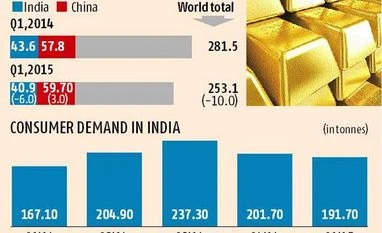
BS Reporter Mumbai India’s gold demand, particularly for jewellery, rose 22 per cent in the March quarter from a year before, to 150.8 tonnes. This was accompanied by a six per cent fall in investment-related gold demand, at 40.9 tonnes.
This data comes from the World Gold Council (WGC). It says this is the first quarter since 2012 when gold demand by exchange traded funds (ETFs) showed net buying, of 25.7 tonnes. Through 2014, ETFs had net-sold gold.
The report is cautious about this demand continuing in the June quarter. “The unseasonal rain and hailstorms that hit some parts of the country in late March and early April might undermine some elements of rural demand. However, the drop might not be significant during the course of the year,” it said.
Data for the report has been collected by Metal Focus. Until the December 2014 quarter, the data was provided by GFMS Thomson Reuters.
Globally, the report said, “Demand dipped by one per cent to 1,079.3 tonnes in a generally quiet quarter. Growth in India and the US could not prevent a modest downtick in jewellery demand. Light inflows into ETFs, the first since 2012, boosted investments.”
India’s total demand for gold in the quarter was 15 per cent higher at 191.7 tonnes. China remained the world’s top gold consumer, with quarterly demand at 272.9 tonnes, though this was a seven per cent fall from a year before.
Alistair Hewitt, head of market intelligence at WGC, said: “Once again, consumers in Eastern countries dominated the market, with China and India alone accounting for 54 per cent of total global consumer demand in the quarter.”
The report is also cautious on a rise in Indian demand. “The 22 per cent increase in jewellery demand was more a reflection of unusual weakness in the year-earlier period than any particular strength in the quarter,” it said. It noted that despite permitting the import of coins, investment demand didn’t pick-up, though gold continues to enter the country ‘unofficially’.
The first quarter of last year saw a combination of factors discourage jewellery purchases, the report said, pointing to strong import curbs, the impending elections that created uncertainty, and temporary restrictions on free movement of cash and assets such as gold. In comparison, conditions in the March quarter were far more encouraging, with demand only three per cent below its five-year quarterly average of 154.7 tonnes, it noted.
Central banks continued to be strong buyers, purchasing 119 tonnes in the quarter, the same as in the March quarter of 2014. This was the 17th consecutive quarter that central banks have been net purchasers of gold, as they continue to seek diversification away from the dollar.
Total supply was almost unchanged at 1,089 tonnes. A two per cent rise in mine production to 729 tonnes was balanced by a three per cent fall in recycling to 355 tonnes, compared with the same quarter last year.

 "India gold demand up 22% but WGC cautious on outlook")


 Connect with us on WhatsApp