
Metals fall on weak Chinese demand
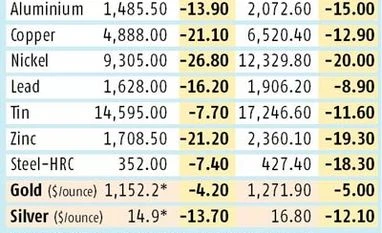
Metals decline on weak global demand, fears of steeper-than-expected Chinese economic slowdown weighs on commodities
 "Metals fall on weak Chinese demand")
WebinarsNew
Deep DiveNew
Explore Business Standard
Metals decline on weak global demand, fears of steeper-than-expected Chinese economic slowdown weighs on commodities
Industrial commodities' price fell sharply in the last three months following global trend as a sharp decline in equity market fears the Chinese economy heading into a steeper-than-expected economic slowdown.
Globally referenceable commodities, normally, move in India in sync with global markets. Some commodities that follow local issues like demand-supply arithmetic, government policies, taxes etc., move solo for some time in Indian markets versus their global references. But, over a period of one - two week, they follow the move in global markets.
This necessarily means, domestic consumers may get advantage in case of lower price in Indian versus imported commodities for a short period. But, the benefit may be wiped out for long term. Similarly, in case of higher domestic prices, consumers should abstain from fresh buying as commodities' price would come back in sync with global move.
"In domestic market, globally referenceable commodities move in sync with global markets. The objective of the commodities' movement in local market in sync with global markets is to avoid cash-future arbitrage for traders. In cases when commodities are traded on global platforms and not in domestic markets due to variation in trading time, traders get advantage of cash - future arbitrage. But, that is just for a short period. Considering a long period of a week or two, prevailing price of commodities broadly follow global trend," said Gnanasekar Thiagarajan, Director, Commtrendz Research.
China consumes over 40% of global base-metals supply. As a result, metal prices tend to mirror Chinese economic trajectory closely. When Chinese economy is seen to be in trouble, market participants anticipate demand declines and price falls.
The reverse trend is seen especially when either individual currency or commodity price is highly volatile. In case of stability, the price in India truly reflects global trend.
"Rupee's depreciation has capped reflection of global commodities fall in Indian to certain extent. Fundamentals in respective commodities also determine the price movement in local currency. India is too small a player to determine their prices. Depreciation in the rupee will always play a part. But, because of the local issues including demand-supply situation, commodities' price may not follow global move for a couple of days. But, prices in Indian broadly follow long term global move," said Jayant Manglik, President (Retail Distribution), Religare Securities Ltd.
Meanwhile, gold was selling at a premium of $1 per 10 grams in early Tuesday trade in tandem with the fall in Asian equity markets. But, later the premium was absorbed fully with gold price settled Rs 27030 per 10 grams, a decline of Rs 505 from previous day, following sharp decline in international market. After opening high at $1170, gold fell sharply to trade at $1150 an oz in London in early afternoon trade.
Meanwhile, the Indian rupee has depreciated by 3.60% since August 11, the day China devalued Yuan, and 5.52% since January this year.
First Published: Aug 25 2015 | 10:33 PM IST


 Connect with us on WhatsApp