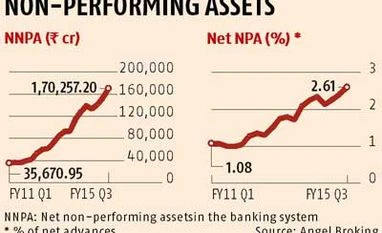
Although Moody’s Investor Service changed India’s outlook to ‘positive’ from ‘stable’ on Thursday, the rating agency also highlighted concerns regarding India’s banking sector’s asset quality.
While Moody’s remains optimistic on the outlook for the economy and the government’s reform process, it has warned that Indian banking system’s asset quality, loan loss coverage and capital ratios are relatively weak.
According to the rating agency, this poses sovereign credit risks due to the banking sector’s role in financing growth and the government’s deficits through its purchase of government securities, and the contingent liabilities owing to the government’s ownership of a major portion of the banking sector.
“In the absence of any improvement in banking system metrics over the coming months, India’s sovereign credit profile will remain constrained,” it says. However, Moody’s believes the ability of policymakers to strengthen India’s sovereign credit profile to a level consistent with a higher rating will only become apparent over the next 12-18 months.
Despite Moody’s flagging off concerns, banking stocks gained ground on Thursday with the Bank Nifty gaining 2.5 per cent to 18,876 levels. In comparison, the benchmark indices, the S&P BSE Sensex and the CNX Nifty, ended 0.7 per cent higher.
Punjab National Bank (PNB), IndusInd Bank, Kotak Mahindra Bank, Bank of India, Axis Bank, Canara Bank, State Bank of India (SBI) and YES Bank were among the top gainers among the banking stocks, that moved up between 2.5 and seven per cent.
Slow road to recovery Analysts believe the concerns highlighted by Moody's are not new and going ahead, the problems in the banking sector will mend. However, they caution this will be a long-drawn process.
Directionally, they suggest, things have started to improve for the banking sector, although the pace of improvement is a little slow. Banks’ earnings in the fourth quarter of FY15 and the next two quarters of FY16 might not be good and the stressed assets should peak in the March 2015 quarter. By the end of FY16, the level of stressed assets in the system should be lower than in the previous year.
“It is quite evident from the data the kind of stress there is in the banking system, primarily in the public sector banks (PSBs). But from a forward looking view, the government’s reform process should start revising the core sectors like infrastructure, power, metals etc. So, the stress levels in these banks should start coming down from FY16 and FY17 onwards,” said Vaibhav Agra-wal, vice-president (research - banking) at Angel Broking.
“If we put together power, infrastructure and roads, they in total account for 60-70 per cent of the restructured assets. What’s left, then, is textiles and chemical sectors that are export-oriented and have stress. As regards agriculture, there are well-defined systems in place that address issues like erratic monsoon or crop failure where banks need to deal with such accounts,” he adds.
Ankit Ladhani, an analyst tracking the sector with Karvy Stock Broking, also expects asset quality concerns for the banking sector to continue in the fourth of FY15 results as well. The performance of private banks, however, is expected to be better than that of PSBs, although they are also expected to report higher slippages and restructuring. He maintains a ‘buy’ rating on Axis Bank, DCB Bank, Federal Bank, ICICI Bank and YES Bank; and a ‘hold’ rating on HDFC Bank.
Santosh Singh, an analyst tracking the sector with Societe Generale, maintains a ‘buy’ recommendation on HDFC Bank, SBI and ICICI Bank in a March 2015 report. Key catalysts would be an interest rate cut or signs that the economy is recovering, he says.

 "Moody's red flags banking sector; cites asset quality concerns")


 Connect with us on WhatsApp