Nashik's Lasalgaon Mandi remains shut as govt raids large onion farmers

The street remained deserted with onion growers abstaining from bringing any stock to the yard
infographic
Dilip Kumar Jha Mumbai
Last Updated : Sep 16 2017 | 1:55 AM IST
Onion traders have lodged a massive protest over the raids conducted by the government on large farmers and stockists across Nashik district in Maharashtra for allegedly holding stocks with an aim to manipulate prices artificially.

The Agricultural Produce Market Committee (APMC) at Lasalgaon, Asia's largest onion market yard, remained shut on Friday. The street remained deserted with farmers abstaining from bringing any stock to the yard. The buyers were also not allowed to enter the market while raids from the income tax department and the local government authorities were underway.

Thousands of farmers, stockists and traders have decided to gather across Nashik district at the local taluka level to decide on the next course of action. Angry farmers, traders and stockists are planning to go on strike protesting the raids conducted by the income tax department and the local authorities. Trade sources said a number of large farmers and stockists were raided on Thursday to create pressure for releasing more onion into the market to bring down prices. 

The authorities conducted the raids after the Consumer Price Index (CPI) and the wholesale price index (WPI) for August on Wednesday and Thursday respectively showed that food inflation is up due to a sharp rise in onion prices.

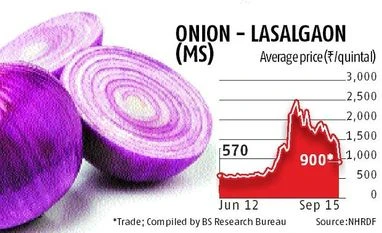
In the deal, however, onion prices slumped by 35 per cent, perhaps the largest one-day decline, on Friday to trade at Rs 9 a kg from the level of Rs 14 a kg two days ago and Rs 18.20 a kg early this month. Interestingly, onion arrivals in Lasalgaon mandi declined to 800 tonnes on September 13 from 2226.5 tonnes on September 4.

"The Lasalgaon mandi remained closed on Friday due to farmers' and stockists' apprehensions over trade in onion. The government is looking at us suspiciously. When onion prices went down to much below the cost of production of Rs 5-5.50 a kg early this year, no one came forward to protect us.

This means, the government is not bothered about farmers' survival and only concerned about keeping the prices low. Hence, raids on traders and large farmers are completely unacceptable as September and October are the only time across the year when farmers can fetch little higher price. To accelerate our protest, all stakeholders, including farmers, traders and stockists are meeting tomorrow to take next course of action against the government actions," said Sanjay Sanap, a large onion trader in Lasalgaon, Nashik.

Echoing similar views, another large trader Santosh Chavan, said, "The government of Maharashtra should buy onion from farmers at lower price and then distribute it to consumers similar to the practice done by the state government of Madhya Pradesh. When onion prices started moving up about a month ago, the government allowed its import from Turkey which landed in Indian markets at Rs 22 a kg. This means, domestic traders would not sell their stock below this threshold of Rs 22 a kg."

Due to excessive rainfall and supply disruptions, onion price was hovering between Rs 16-22 a kg over the last one month. According to trade sources, there is a huge demand of onion from Pakistan. Indian traders were exporting onion to Pakistan in the past years. But, no consignment is going to Pakistan by land route through Wagah boarder.

"Prices have declined on fears of raids. Traders want to stay away from large orders either side (buy / sale) to evade the eyes of tax authorities," said Ajit Shah, President, Horticulture Exporters Association.

Meanwhile, India's onion exports have jumped by a staggering 61 per cent during April-June quarter of the current financial year to 945,262 tonnes (worth Rs 1,098 crore) compared to 587,476 tonnes (valued Rs 721 crore) in the corresponding quarter last year.

One subscription. Two world-class reads.

Already subscribed? Log in

Subscribe to read the full story →
*Subscribe to Business Standard digital and get complimentary access to The New York Times

Smart Quarterly

₹900

3 Months

₹300/Month

SAVE 25%

Smart Essential

₹2,700

1 Year

₹225/Month

SAVE 46%
*Complimentary New York Times access for the 2nd year will be given after 12 months

Super Saver

₹3,900

2 Years

₹162/Month

Subscribe

Renews automatically, cancel anytime

Here’s what’s included in our digital subscription plans

Exclusive premium stories online

  • Over 30 premium stories daily, handpicked by our editors

Complimentary Access to The New York Times

  • News, Games, Cooking, Audio, Wirecutter & The Athletic

Business Standard Epaper

  • Digital replica of our daily newspaper — with options to read, save, and share

Curated Newsletters

  • Insights on markets, finance, politics, tech, and more delivered to your inbox

Market Analysis & Investment Insights

  • In-depth market analysis & insights with access to The Smart Investor

Archives

  • Repository of articles and publications dating back to 1997

Ad-free Reading

  • Uninterrupted reading experience with no advertisements

Seamless Access Across All Devices

  • Access Business Standard across devices — mobile, tablet, or PC, via web or app

Next Story



