US data outshine India's narrowing trade deficit
Foreign investors sell $2.4 bn in debt market, as Dollar Index rises
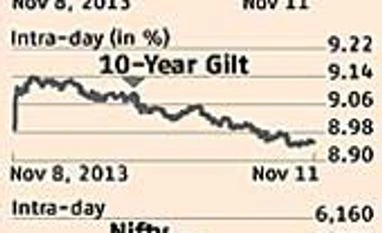
Malini Bhupta Mumbai Even though India’s trade deficit for October is in the manageable zone at $10.6 billion, financial markets are not rejoicing. On Monday, the rupee fell 1.22 to 63.24 and the benchmark Nifty 50 fell by a per cent and bond yields rose.
Rather than reacting to October’s trade data, the rupee has reacted to the rising Dollar Index and foreign investors selling Indian bonds. Foreign investors have sold bonds worth $2.4 billion since October and the dollar index has risen by 2.4 per cent over the past two weeks.
Adding to this is the stream of positive data emanating from the US. Economists believe the flow of capital to countries like India could soon reverse easily, if the US Fed even hints at tapering its bond purchase programme. Going by the positive data emerging from the US, chances of that happening are increasingly getting brighter. Despite the 16-day government shut-down, the US added 204,000 jobs in October and unemployment rate rose to 7.3 per cent in October from 7.2 per cent in September.
The reason: even government employees were considered to be unemployed during the month due to the shut-down, which means that November's data may be even better. In the third quarter, the US economy grew at 2.8 per cent, better than what is expected for the full-year. Leif Eskesen, HSBC’s chief economist for Asia and Asean, says investors must not lose sight of the risks ahead. While growth will return to emerging countries in 2014, as the global economy revives, growth will be more difficult to come by in coming years, adds Eskesen.
Four consecutive months of improvement in India's exports lend credence to this theory. Compared to last year, October's exports rose 13.5 per cent to $27.3 billion. The trade deficit has not narrowed merely because of the central banks curbs on gold imports alone. Thanks to slowing growth, imports are down 14.5 per cent to $37.8 billion compared to the year-ago period. Oil imports, too, have remained flat through the first six months of the new fiscal.
Excluding oil and gold, imports have dropped 5.6 per cent in October compared to last year. Economists expect trade deficit to remain below $10 billion in the October-December quarter. Tirthankar Patnaik, chief economist at Religare Institutional Equities, believes his estimates on the current account deficit ($55 billion or 3.2 per cent of GDP) faces downside risks now.

 "US data outshine India's narrowing trade deficit")


 Connect with us on WhatsApp