PSBs lose Rs 1 trn; PNB scam erodes investor interest spurred by recap plan

The government's recapitalisation plan, announced on October 24, raised the PSU Bank Index to a high of Rs 3,965.60 by January 24
PSBs lose Rs 1 trn; PNB scam erodes investor interest spurred by recap plan
Advait Rao Palepu Mumbai
Last Updated : Feb 21 2018 | 7:05 AM IST
Over the last five months, it seemed like the Nifty PSU (public sector undertaking) Bank Index was gaining, with increased investor interest on account of the government's recapitalisation plan.

However, after the Punjab National Bank (PNB) scam, the indication of possible system-wide fraud has caused the index to fall 22 per cent from its January high, erasing Rs 1 trillion in value.

The government’s recapitalisation plan, announced on October 24, raised the PSU Bank Index to a high of Rs 3,965.60 by January 24. After which, it was stable for a while, each trading session’s closing price being lower than on the previous day.

On February 14, the government-owned Punjab National Bank (PNB) revealed some rogue employees had issued letters of undertaking (LoUs) via the SWIFT (Society for Worldwide Inter-Bank Financial Telecommunication) system on behalf of companies belonging to diamantaire Nirav Modi and associate Mehul Choksi.

The bank told regulators its foreign exchange department in Fort, Mumbai, had issued $144 billion worth of fraudulent LoUs since 2011, against which buyer credit was extended by overseas branches of others Indian banks. These SWIFT messages were sent to the latter without being entered into PNB’s core banking system (CBS); hence, the fraud went undetected for years, the management said.

As reported by Business Standard on February 20, the department of financial services is likely to hold a meeting with the information technology teams of all PSU banks soon, having already communicated that they must integrate their CBS with the SWIFT system.

This development has made investors and the wider public wary about the future of PSU banks. There is a sense that the scam is not restricted to PNB and that: i) there is no clear indication that the LoU service was not exploited by employees at other banks; ii) that there are numerous undetected (fraud) SWIFT messages that have not been accounted for by the CBS of various banks and; iii) that the LoU arrangement is in itself heavily compromised, as there is little diligence, compliance and oversight by banks at both ends of the transaction.

Indian banks on the other end of the fraud have chosen to settle this issue bilaterally with PNB, with the latter open to seeking legal remedies. Business chambers and bank employee unions argue over the issue of privatising the country’s second largest PSU bank.

The sentiment and belief that there is a lack of accountability, little due-diligence and that political patronage runs public banks has caused the Nifty PSU Bank Index to turn downward since end-January.

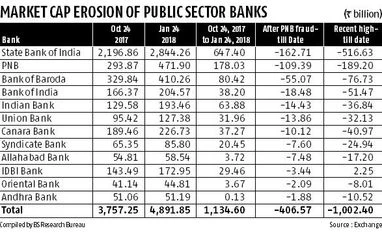
Reveals the PSU bank-wise market capitalisation erosion since details of the fraud emerged. State Bank of India has lost Rs 162 billion, followed by PNB losing Rs 109 billion, Bank of Baroda losing Rs 55 billion and Bank of India losing Rs 18.5 billion. The government, the majority shareholder in PSU banks, has seen its holding fall by Rs 590 billion in value. Life Insurance Corporation saw its stake shrink in value by Rs 120 billion, according to a BloombergQuint report.

Since the PSU Bank Index's recent high in January, around Rs 1 trillion in market capitalisation has been wiped out, while Rs 406 billion in market capitalisation has vanished since PNB’s revelation.

Analysts say rising bad assets have increased the fragility of public sector banks. And the slow nature of the Insolvency and Bankruptcy Code process has not provided comfort to institutional investors. Also, that the scam indicates a seeming inability of PSU banks to be both efficient and accountable.

It is interesting to note how two different news events affected the PSU Bank Index. The first one, triggering fierce interest and confidence in these banks, was the government's announcement of a Rs 2.11 trillion recapitalisation plan. This spurred investor interest and made the index jump.

The second news item was PNB's revelation of a massive fraud, which dampened investor sentiment and caused many to sell their positions. And, it brought to the fore the fact that the underlying issues of banking governance, transparency, accountability and oversight mechanisms, and trust, still needed to be addressed. More so now than ever before.

One subscription. Two world-class reads.

Already subscribed? Log in

Subscribe to read the full story →
*Subscribe to Business Standard digital and get complimentary access to The New York Times

Smart Quarterly

₹900

3 Months

₹300/Month

SAVE 25%

Smart Essential

₹2,700

1 Year

₹225/Month

SAVE 46%
*Complimentary New York Times access for the 2nd year will be given after 12 months

Super Saver

₹3,900

2 Years

₹162/Month

Subscribe

Renews automatically, cancel anytime

Here’s what’s included in our digital subscription plans

Exclusive premium stories online

  • Over 30 premium stories daily, handpicked by our editors

Complimentary Access to The New York Times

  • News, Games, Cooking, Audio, Wirecutter & The Athletic

Business Standard Epaper

  • Digital replica of our daily newspaper — with options to read, save, and share

Curated Newsletters

  • Insights on markets, finance, politics, tech, and more delivered to your inbox

Market Analysis & Investment Insights

  • In-depth market analysis & insights with access to The Smart Investor

Archives

  • Repository of articles and publications dating back to 1997

Ad-free Reading

  • Uninterrupted reading experience with no advertisements

Seamless Access Across All Devices

  • Access Business Standard across devices — mobile, tablet, or PC, via web or app

Next Story



