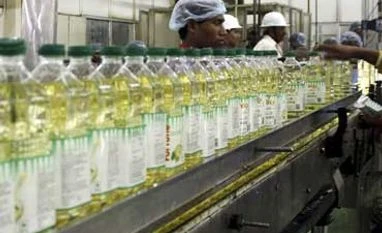
Faced with tremendous margin pressure, edible oil producers have shifted from selling loose oil in container form to value-added and branded products.
The switchover has rescued many small and regional entities from threatened closure and helped large entities such as Ruchi Soya Industries, Adani Wilmar and Cargill to fetch premiums of up to 30 per cent over loose oil in bulk containers. The larger players have also started better prospects in the promotion of value-added products with health benefits.
As a consequence, the share of branded and packaged segments in edible oil sales is now 65–70 per cent from 30-35 per cent five years ago, with a compounded annual growth rate of 15 per cent. “This is a natural transition with the change in consumer preferences. There has been a rapid shift towards packed oil from loose oil in the past few years,” said Siraj Chaudhry, chairman, Cargill India, producer of the NatureFresh, Gemini and Sweekar brands.
The shift has been rapid due to squeezing of producer margins between high oilseed and low oil prices. While the government has continued to raise the minimum support price (MSP) of oilseeds, resulting in a sustained rise in input cost, falling edible oil prices globally have made survival difficult for seed crushers. The MSP of groundnut in shells was raised to Rs 4,030 a quintal for 2015-16 from Rs 2,300 a qtl for 2010-11. For soybean (yellow), it was raised to Rs 2,600 a qtl for 2015-16 from Rs 1,440 a qtl five years before.
Prices of edible oil have slid in the past five years due to a global supply glut and reduced demand from the biofuel sector. After a record of 3,982 ringgit a tonne, crude palm oil (CPO) on the benchmark Bursa Malaysia slumped to 1,800 ringgit a tonne in August last year. It has since recovered, to trade currently at 2,454 ringgit a tonne.
KEY TAKEAWAYS
Share of branded and packaged segments in edible oil sales grew at a compounded annual rate of 15%
The shift towards packed oil has been rapid due to squeezing of producer margins between high oilseed and low oil prices
While the MSP of oilseeds has been raised, falling edible oil prices globally have made survival difficult for seed crushers
Prices of edible oil have slid in five years due to a global supply glut and reduced demand from biofuel sector
Squeezing of margins has resulted in shutting down of small entities, giving larger players an opportunity
India produces around eight mt of edible oils against annual consumption of 23 mt, the difference being made up by exports
“We were selling 65 per cent loose oil and the remaining 35 per cent packed oil five years ago; this has reversed. Within the packed oil segment, we have focused more on branding. So, despite doubling of oil volumes in five years, contribution of the branded and packed segment has surged within our group,” said Satendra Aggarwal, operations head at Ruchi Soya Industries, producer of the Mahakosh, Sunrich and other brands. With the branded segment in focus, group revenue has grown to Rs 18,000 crore annually from Rs 8,000 crore five years before.
Squeezing of the margins, however, has resulted in the shutting down of small and regional entities, opening an opportunity for national brands to grab their share.
“Since oilseed availability has been either constant or has declined in India, the government should reduce import duty on these to enable crushers to procure from foreign markets,” said Atul Chaturvedi, chief executive officer at Adani Wilmar, producer of the Fortune brand of edible oil. On Monday, it had launched an ‘anti-diabetic’ brand, Vivo.
The country's oilseed output was 26.7 mt for 2014-15, against 32.5 mt in 2010-11. India produces around eight mt of edible oils against annual consumption of 23 mt. The difference is met through import from Malaysia, Indonesia, Brazil and Argentina.

 "Segment shift in edible oil sales")


 Connect with us on WhatsApp