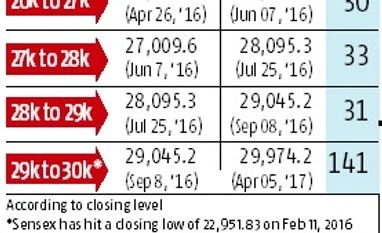
The BSE Sensex crossed the 30,000 mark for the first time in about two years, as the Indian equity markets went up for a consecutive session. The Sensex gained 64 points, or 0.2 per cent, during the session to end at 29,974.2, while the NSE’s Nifty closed at 9,265 — 27.3 points, or 0.3 per cent — higher. Both indices closed at new lifetime highs.
The broader markets outperformed, with the small-cap index climbing 1.1 per cent and the mid-cap index rising 0.46 per cent.
The overall breadth of the market remained positive, with shares of 1,987 companies registering gains, against declines posted by 936 companies.
The Sensex recorded an intra-day high of 30,007.5, but slipped below the 30,000 mark, as investors adopted a cautious strategy ahead of the Reserve Bank of India’s (RBI’s) bi-monthly monetary policy review on Thursday.
Market participants said the investor sentiment was positive with the victory of the Bharatiya Janata Party in the Uttar Pradesh Assembly elections and with the passage of the Goods and Services Tax Bill in Parliament.
“Improved macroeconomic numbers, such as the sharp reduction in the current account deficit, are resulting in a lot of funds flowing into Indian equity, both from domestic and global institutions,” said Kunj Bansal, chief investment officer, Centrum Broking.
Wednesday’s rally was powered by Reliance Industries, Maruti Suzuki, Adani Ports and Larsen & Toubro. Shares of Adani Ports went up 4.5 per cent, the best show by a Sensex constituent company during the session. Shares of Maruti and RIL went up 4.4 per cent and 3.2 per cent, respectively.
The rally has been supported by strong foreign fund flows. Foreign portfolio investors bought equities worth Rs 340 crore on Wednesday.
On the other hand, domestic institutions sold shares worth Rs 194 crore, BSE data showed. Market participants said though stock valuations have gone up significantly during the current leg of the rally, the Indian market was not still expensive, if the revival in earnings was factored in. The one-year forward price-earnings value of the Sensex is currently 22.
“The Nifty’s earnings performance has been flat over the past three years, with EPS (earnings per share) fluctuating around Rs 400 over FY14-17. Going forward, we are estimating a healthy earnings growth of 21 per cent on a CAGR (compound annual growth rate) basis, aided by a low base of second half of FY17 and a recovery in metals, government banks, and oil and gas. The macro backdrop remains conducive,” said Dharmesh Kant, head of retail research, Motilal Oswal Securities. Kant expects the Nifty to cross the 10,000 mark in FY18.
The current rally in the markets is being supported largely by metals, oil and gas, and telecom stocks along with traditional alpha sectors like banking and information technology stocks. All these sectors did badly between FY14 and FY16, due to a variety of factors, including low commodity prices globally and decreasing margins.
However, analysts warned any disappointment in corporate earnings could bring a correction in the markets. Further, global factors, including policies adopted by US President Donald Trump and political developments in Europe, as well as a possible referendum by Italy to decide on the fate of its membership in the European Union, could act as tailwinds for Indian markets, experts added.