3 min read Last Updated : Mar 26 2020 | 9:42 AM IST
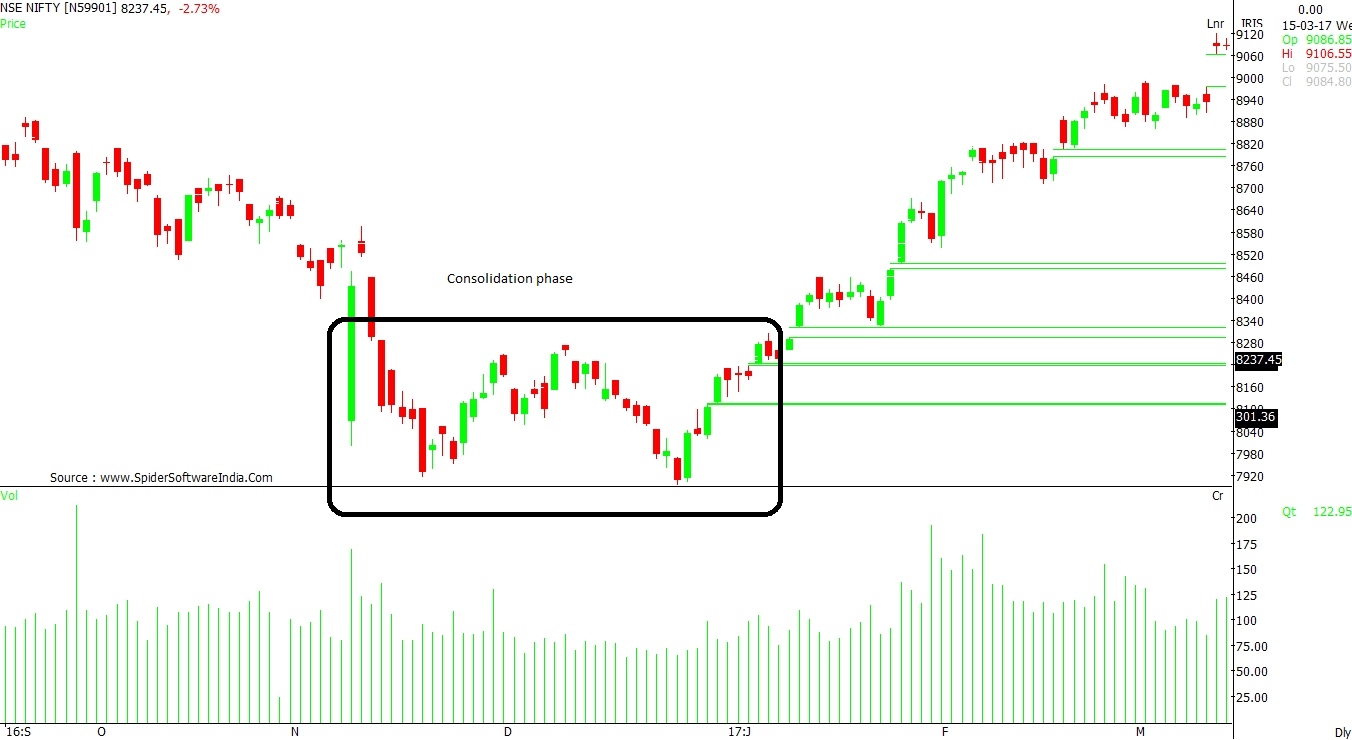
Consolidation is a phase when a stock or an index trades within a range. The trend is said to be sideways and may vary depending on the circumstance. Once this range is broken, it may lead to bigger moves, but until the range is intact, the movement cannot be clearly predicted.
Indicators like volumes and technical instruments like Relative Strength Index (RSI) and Moving Average Convergence Divergence (MACD) assist in the confirmation of a firm breakout.
Key aspects of a consolidation phase
Longer the consolidation period, the bigger is the movement on the breakout. Longer time periods assist in developing strong support levels.
Stocks/indices forming highs/lows at nearby levels during consolidation develop strong buying supports or selling resistance.
The phase also assists in identifying the bottom/ top of the markets. Such consolidation facilitates in determining a medium-term outlook.
Consolidation shows a new trend in place. A major shift in trend with a change in sentiment may be noticed after a breakout.
Volume plays a crucial role in the breakout. Stronger the volumes, higher the chances of the correction gaining firm buying support.
Forms of a consolidation phase
Consolidation appears in different forms. The basic one is a horizontal sideways range. However, the phase may be in a triangular shape as well -- Symmetrical Triangle, Ascending triangle, and Descending triangle eventually show breakout from the trendline formed by connecting the range's highs/lows.
Symmetrical Triangle: The price moves within the trend line formed by connecting the highs and lows. The breakout happens when the two trend lines converge.
Ascending Triangle: The price forms highs around a similar level while the lows form “lower lows” before breaking out.
Descending Triangle: A breakdown pattern, herein the lows formed around the similar levels are broken.
How to trade in a consolidation phase
Whenever a stock shows a consolidation pattern, one needs to wait for the breakout. The support or resistance levels will indicate the possible reversal points. If the stock holds the levels with decent volumes, then the breakout will show a stable rise. Even the correction, if any, then shows firm upside buying momentum. Huge volumes with high volatility may result in an uncertain movement in price upon the breakout, which shows unstable sentiment.
The price target for the breakout is the difference between the high and low levels of the range. The price may rise further, even to the double of the consolidation range. The time period to achieve the target depends on the consolidation. Longer the consolidation, shorter is the time required to achieve the price target.
Stop loss is the support and resistance levels indicated by the nearing lows and highs. After an established breakout, the stop loss may be shifted to the average of the consolidation range.CLICK HERE FOR THE CHART