On Tuesday, nine months after Prime Minister Narendra Modi laid the foundation stone at Tumakuru (Karnataka) for Hindustan Aeronautics Ltd (HAL)’s new helicopter manufacturing complex, the helicopter to be built there made its inaugural flight.
The light utility helicopter (LUH) will replace the military’s obsolescent fleet of Chetak and Cheetah helicopters that have flown for over three decades. The defence ministry is following a dual track — HAL is designing, developing and building 187 LUHs, while importing-cum-building 197 Kamov-226T light helicopters with technology from Russia.
“Apart from replacing ageing fleet of Cheetah/Chetak, LUH is expected to capture a sizeable share both in domestic and international market,” HAL stated.
In the test, which HAL described as “flawless”, veteran test pilots, Wing Commanders Unni Pillai and Anil Bhambari, got airborne and carried out a few basic turns and manoeuvres. Helicopter testing is unforgiving, since pilots have no way of bailing out of a chopper that loses control.
Veteran test pilots like Pillai are part of an experienced HAL helicopter division that has already masterminded two successful indigenous programmes — the Dhruv Advanced Light Helicopter (ALH) that is serving the army in large numbers; and the Light Combat Helicopter (LCH) that is undergoing flight-testing before being inducted into the Army and Air Force.
HAL intends to speed up flight-testing of the LUH by distributing it over three prototypes. It hopes to obtain initial operational certification by end-2017. Limited series production will be done in Bengaluru, and the 610-acre Tumakuru unit is slated to commence production in 2018-19. The initial investment for the Tumakuru project could be of the order of Rs 2,000 crore.
According to HAL’s internal manufacturing targets, the Tumakuru plant will ship about 30 LUHs annually, starting in 2019-20. In phase II, which will take another three-four years, production will be ramped up to 60 helicopters per year. HAL described the LUH as a light, single-engine helicopter that is powered by the Safran HE Ardiden-1U engine. In addition to two pilots, the helicopter can fly six passengers at sea level, with load capacity reducing with altitude. The LUH’s engine, which delivers 750 kilowatts of power, permits flight operations at as high as 6,500 metres (21,325 feet). That would allow it to fly to India’s highest posts in the Siachen Glacier sector.
HAL says the LUH has an “all-up weight” of 3,150 kilogrammes, which places it in the three-tonne class. Its operating range of 350 km allows it to carry out various roles, including reconnaissance, transport, cargo load and high-altitude rescue operations. The twin-engine Dhruv ALH, which is a five-tonne class helicopter, was initially sold by HAL to the military for about Rs 40 crore, but the current order is likely to be priced at Rs 65-70 crore ($10 million). By that yardstick, industry analysts estimate the smaller LUH would be delivered at about Rs 40 crore per piece; and the 200-helicopter order would be worth Rs 8,000 crore.

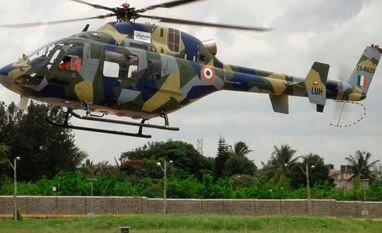 "HAL's light utility helicopter takes inaugural flight")


 Connect with us on WhatsApp