
At dinner with Obama, Modi urges global unity against terror
The PM made a strong call to the world to drop the notion that terrorism is someone else's problem & that 'his' terrorist is not 'my' terrorist
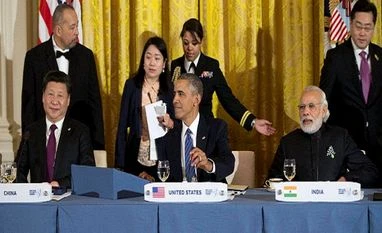 "At dinner with Obama, Modi urges global unity against terror")
WebinarsNew
Deep DiveNew
Explore Business Standard
The PM made a strong call to the world to drop the notion that terrorism is someone else's problem & that 'his' terrorist is not 'my' terrorist
As leaders from over 50 nations gathered in Washington to discuss the nuclear terror threat, Prime Minister Narendra Modi made a strong call to the world to drop the notion that terrorism is someone else's problem and that "his" terrorist is not "my" terrorist.
"Terrorism is globally networked. But, we still act only nationally to counter this threat," Modi said at a working dinner hosted by President Barack Obama Thursday night to kick off the two-day Nuclear Security Summit.
"Nuclear security must remain an abiding national priority and all states must completely abide by their international obligations," Modi told the world leaders meeting in the shadow of Brussels and Lahore terror attacks. .
"Without prevention and prosecution of acts of terrorism, there is no deterrence against nuclear terrorism," he warned lamenting that while "the reach and supply chains of terrorism are global, genuine cooperation between nation states is not".
Obama, who is hosting his fourth and last such summit to discuss how to prevent terrorists and other non state actors from gaining access to nuclear materials, was flanked by Modi to the right and Chinese President Xi Jinping on the left.
The "dinner table" ran along the circumference of the East Room of the White House. In the middle were three big boxes of flowers, according to a pool report.
Modi, who has come to Washington after attending the India-EU summit in the Belgian capital, said: "Brussels shows us how real and immediate is the threat to nuclear security from terrorism.
"Terror has evolved. Terrorists are using 21st century technology. But our responses are rooted in the past," he said asking the leaders to focus on three contemporary features of terrorism.
"First, today's terrorism uses extreme violence as theatre. Second, we are no longer looking for a man in a cave, but we are hunting for a terrorist in a city with a computer or a smart phone.
"And third, state actors working with nuclear traffickers and terrorists present the greatest risk."
By putting spotlight on nuclear security, Obama has done great service to global security, Modi said and "this legacy of President Obama must endure".
Earlier, in an opinion piece in the Washington Post on Thursday Obama said: "Of all the threats to global security and peace, the most dangerous is the proliferation and potential use of nuclear weapons."
Outlining how to make the vision of a world without nuclear weapons a reality, he wrote: "We're clear-eyed about the high hurdles ahead, but I believe that we must never resign ourselves to the fatalism that the spread of nuclear weapons is inevitable."
"Even as we deal with the realities of the world as it is, we must continue to strive for our vision of the world as it ought to be," Obama wrote.
Secretary of State John Kerry and Secretary of Energy Ernest Moniz co-hosted a separate working dinner for other members of the visiting delegations.
"In recent years, 13 countries, plus Taiwan, have given up weapons-usable plutonium and highly-enriched uranium entirely," Kerry noted. "An additional 12 countries have decreased their stockpiles of nuclear material."
Since 2009, through various lines of effort, we have removed or eliminated enough weapons-grade fissionable material to supply nearly 7,000 nuclear bombs," he said.
India and other participating nations will present their national progress reports on steps taken by them to strengthen nuclear security since the last summit on Friday.
The first of these biennial nuclear security summits was held in Washington in April 2010 followed by the summits in Seoul in March 2012 and The Hague in March 2014.
First Published: Apr 01 2016 | 3:42 PM IST


 Connect with us on WhatsApp