
Sushma Swaraj at BRICS meet: Must condemn countries sponsoring terrorism
'Terrorist funding, weapons supply, training, political support must be cut off,' she said sitting around the same table as China's Foreign Minister
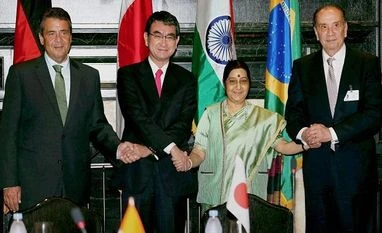 "Sushma Swaraj at BRICS meet: Must condemn countries sponsoring terrorism")
WebinarsNew
Deep DiveNew
Explore Business Standard
'Terrorist funding, weapons supply, training, political support must be cut off,' she said sitting around the same table as China's Foreign Minister
India's External Affairs Minister Sushma Swaraj on Thursday said that the five-member BRICS, which includes China, should work to end terrorism's "support systems in South Asia," making a pointed reference to Beijing's ally, Islamabad.
At a ministerial-level meeting of BRICS here, she said without naming any country: "Terror groups draw sustenance from support systems in South Asia."
"Terrorist funding, their weapons supply, training and political support must be systematically cut off," she said sitting around the same table as China's Foreign Minister Wang Yi. "There is a need for collective efforts to disrupt terrorist networks, their financing and movement."
China has repeatedly blocked efforts to put United Nations sanction on Pakistan-based Jaish-e-Mohammed chief Masood Azhar, who India says is the mastermind of the 2016 terrorist attack on the Pathankot air force base. It has also protected Pakistan from action for protecting those under UN sanctions.
"We must condemn efforts, including by states, to use religion to justify, sustain and sponsor terrorism against other countries," Sushma Swaraj told the ministers from also other BRICS members, Brazil, Russia and South Africa. "They continue to find support and shelter in countries which use terrorism as an instrument of state policy."
"We must condemn efforts, including by states, to use religion to justify, sustain and sponsor terrorism against other countries," she added.
One of the effective ways to stop cross-country support for terrorism is the Comprehensive Convention on International Terrorism (CCCIT), which has been in a limbo for decades because some countries cannot agree on a definition of terrorists.
Sushma Swaraj asked the BRICS ministers to "work for early conclusion of negotiations and adoption of the CCIT in the United Nations".
On North Korea's recent offensive military posturing, she said: "The action and rhetoric of North Korea has been a source of growing global concern."
She also appealed for joint efforts to reform the International Monetary Fund, where decision-making is still tilted towards major western industrialised countries, and the UN Security Council.
China is opposed to Council reforms that would enlarge the UN's highest decision-making body, especially if it would give India and permanent seat, while Russia has been lukewarm.
Turning to climate change, she suggested an alliance between International Solar Alliance and the BRICS Development Bank.
"I hope we can work together to give this ambitious agenda practical shape in coming months," she said.
First Published: Sep 22 2017 | 10:27 AM IST


 Connect with us on WhatsApp