2+2 steps forward, one step back

An important Indo-US agreement signed, but thorny issues remain
2 2 talks, 2 2 dialogue, India, US, sushma swaraj, narendra modi, Donald trump ,mike pompeo, Money,H-1B visa,Nirmala Sitharaman,America,Trump administration,Indians,Micheal Pompeo,External Affairs Minister,Prime Minister,U.S. Congress,China,President
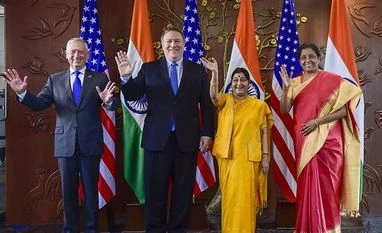
Foreign Minister Sushma Swaraj, Defence Minister Nirmala Sitharaman, US Secretary of State Mike Pompeo and US Secretary of Defence James Mattis pose for a group photo before India-US 2 + 2 Dialogue, in New Delhi. (Photo:PTI)
Business Standard Editorial Comment
Last Updated : Sep 10 2018 | 12:55 AM IST
The 2+2 dialogue between the Union ministers for defence and external affairs and their counterparts from the United States was held last week after delays, which led many to worry about the low priority that Indo-US ties were apparently assigned by the administration of President Donald Trump. In the event the talks were revealing of the strategic vision that unites the two countries — as well as of issues, new and old, that might cause division. The highlight of the talks was certainly the agreement to sign an agreement on security co-ordination, which is a variant of one of the “foundational agreements” that the US has with its close strategic partners.
 
Called the Communications Compatibility and Security Arrangement, or COMCASA, the agreement allows mutual access to encrypted security platforms — which, for example, ensures that the Indian Navy will be able to unlock the full range of capabilities for area awareness embedded in the P-81 surveillance and reconnaissance aircraft that it has bought from the US. These currently operate only with commercially available equipment, no substitute for the controlled suite of communications equipment that will now be available. Warships in the two navies will now also be able to communicate with each other more securely and effectively. The signing of this agreement has been a long-pending requirement to take Indo-US defence co-operation to a new level, and it is to be welcomed that the government has left behind old ways of thinking that feared the implications of opening up encrypted communication to one of India’s strategic partners.

However, there are also divisive issues that were deliberated upon at the 2+2 dialogue. In spite of the fact that strategic and military ties have of late been much warmer and less rocky than economic relations, some problems have also cropped up. Two of these are to do with the implementation of US-led sanctions regimes — against Russia and against Iran. The latter has been a problem before. India, which relies on oil imports, is not pleased at having to cut Iranian oil out of its import mix. A few months ago, External Affairs Minister Sushma Swaraj reiterated that India recognised only sanctions led by the United Nations, which does not include the Iran sanctions, which are being caused by Mr Trump’s decision to withdraw unilaterally from the 2015 nuclear deal with Teheran. It is possible, however, that the US will be satisfied with a major cut in India’s imports from Iran.

The question of defence purchases from Russia is more thorny, as it cuts close to sensitive red lines in New Delhi about strategic autonomy and its long-standing defence partnership with Moscow. The military wants to buy five Russian S-400 surface-to-air missile systems for about $6 billion — which would, if the letter of recent US law is followed, require sanctions to be imposed upon the Indian military in turn. Given the bipartisan support in Washington for sanctions on the Russian military and intelligence, the path forward is uncertain. Yet it is clear that an India-specific carveout will have to be managed or the promising Indo-US strategic relationship will be severely affected. This will have to be managed by Indian diplomacy, through its relationship not just with the US administration but also with Capitol Hill, where the Russian sanctions originated.

One subscription. Two world-class reads.

Already subscribed? Log in

Subscribe to read the full story →
*Subscribe to Business Standard digital and get complimentary access to The New York Times

Smart Quarterly

₹900

3 Months

₹300/Month

SAVE 25%

Smart Essential

₹2,700

1 Year

₹225/Month

SAVE 46%
*Complimentary New York Times access for the 2nd year will be given after 12 months

Super Saver

₹3,900

2 Years

₹162/Month

Subscribe

Renews automatically, cancel anytime

Here’s what’s included in our digital subscription plans

Exclusive premium stories online

  • Over 30 premium stories daily, handpicked by our editors

Complimentary Access to The New York Times

  • News, Games, Cooking, Audio, Wirecutter & The Athletic

Business Standard Epaper

  • Digital replica of our daily newspaper — with options to read, save, and share

Curated Newsletters

  • Insights on markets, finance, politics, tech, and more delivered to your inbox

Market Analysis & Investment Insights

  • In-depth market analysis & insights with access to The Smart Investor

Archives

  • Repository of articles and publications dating back to 1997

Ad-free Reading

  • Uninterrupted reading experience with no advertisements

Seamless Access Across All Devices

  • Access Business Standard across devices — mobile, tablet, or PC, via web or app

Next Story



