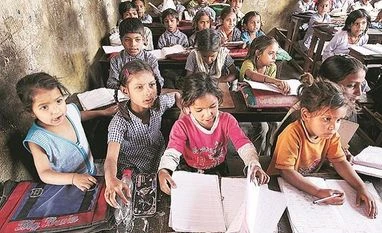
Pratham, a non-governmental organisation engaged in education, has been coming out with its Annual Status of Education Report (Aser) since 2005. And each year’s report has been presenting a dismal picture of primary education in the world’s second most populous country. The reports focus on children aged between 6 years and 14 years in rural India and maps the schooling status of and the “impact” of primary education on a child’s ability to complete basic reading and arithmetic tasks. Despite enacting Right to Education in 2010, which made it incumbent on the state to ensure that each child between the age of 6 and 14 years was provided free and compulsory education, learning outcomes remained poor.
It’s a relief that ASER 2018 is different, even if only slightly. The latest report shows that for the first time since India adopted RTE, reading abilities of Class V students in government schools have improved and their basic mathematical abilities have started growing faster. For instance, the proportion of government school students in Class V, who can read a Class II-level text has risen from 41.7 per cent in 2016 to 44.2 per cent this year. This ratio had been declining from 53.1 per cent in 2008. Similarly, 27.3 per cent of students in Class III can now read a Class II text, up from 21.6 per cent in 2013. There are other bits of good news as well. For instance, India has moved further ahead on gender parity, with the proportion of girls in the age group of 11-14 years who stayed out of school declining from 6 per cent in 2010 to 4.1 per cent in 2018. Moreover, it is the first time that the proportion of children not enrolled in schools has fallen below 3 per cent.
But while these are heartening developments, the broader trend is still worrying. That’s because the basic reading and mathematics abilities of children in Class VIII continue to slowly decline. For instance, among Class VIII students attending government schools, the proportion that can read a Class II text has continued to decline from 83.6 per cent a decade ago to 69 per cent in 2018. The proportion is similar when it comes to mathematical abilities. The picture is slightly more encouraging at the Class III level, where there has been gradual improvement since 2014. However, even in 2018, less than 30 per cent of students in Class III are actually at their grade level, that is, able to read a Class II text and do double-digit subtraction. The performance in private schools is better than government schools. In fact, in private schools, reading and mathematical abilities for students in both Class V and Class VIII have shown improvement.
This means the improvements in educational achievements are not broad-based. In particular, higher primary — that is, class VI to Class VIII — have not shown enough improvements. This is the group that is closest to joining the labour market or the next level of education. But as Aser 2018 that mapped over 546,000 students over 596 districts in India shows, they need adequate foundational skills — that is, literacy and numeracy — among its school-going children. India continues to stare at a crisis if concerted efforts are not taken to correct that.
Read this article for free
Register to continue reading premium journalism and analysis from Business Standard.

 "A glimmer of hope")












 Connect with us on WhatsApp