A Russian reckoning

Ukraine scores unexpected military successes
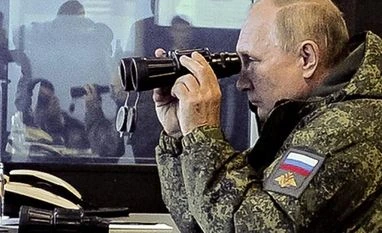
Russian President Vladimir Putin watches the Vostok 2022 (East 2022) military exercise in far eastern Russia, outside Vladivostok (Photo: AP/PTI)
Business Standard Editorial Comment Mumbai
3 min read Last Updated : Sep 12 2022 | 11:04 PM IST
The 200th day of Russia’s invasion of Ukraine has offered a moment of reckoning for President Vladimir Putin’s ill-judged revanchist project. For hard-pressed Ukrainians this grim anniversary offers crucial consolation in terms of a rapid advance of its military in the Kharkiv region in the north-east and the unexpectedly precipitous flight of Russian formations, abandoning all manner of defence equipment, including tanks and rocket launchers. Having recaptured the strategic town of Izyum, which was once a critical jumping-off point for the Russian military, Ukraine’s lightning counter-offensive has brought its forces to less than 50 km from the Russian border. All told, in September, Ukrainian forces claim to have recovered 3,000 square km of lost territory, a fact that has been corroborated by the Russian defence ministry’s publication of a map on Sunday that showed most of its forces were out of Kharkiv.

The Ukrainian force’s advance represents a continuum of its counter-offensive operations that prevented Russian troops from occupying capital Kyiv in March. It also underlines the under-planned and –resourced nature of Russia’s invasion that was on display from the first day of its offensive on February 24. For Ukrainian commanders, the major challenge now lies in planning the subsequent advance cautiously to prevent encirclement. Russia still has a major military presence along the east and south-east, though pockets of Ukrainian counter-offensives along this border plus partisan warfare around the strategic town of Melitopol could be pinning down enemy forces. Still, with a force that is much smaller in terms of personnel and initially out-resourced in terms of military hardware, and short of fuel and food, Kyiv’s staying power has been impressive. Much will be made of the fact that Ukraine’s ability to prevent the Russians overrunning the country has been courtesy the finance and wide range of weaponry from the US and Nato that has proven consistently superior to Russian hardware.

But in geopolitical terms, Moscow appears to have made two critical miscalculations. The first is that European dependence on Russian gas would force it to persuade Kyiv to the negotiating table. Although there are big question marks over Europe’s resilience as the winter approaches, with Russia cutting off supplies from a critical pipeline, the EU has proven pro-active in exploring and operationalising alternative sources. Remarkably, too, public opinion in Europe is still to turn in Russia’s favour. The second critical miscalculation has been the assumption that Kyiv would not be able to hold the line long enough for Western weaponry to enter the war zone. But the fact is that the Ukrainian military has been equipped and trained by the US since Russia’s conquest of the Crimea and the Donetsk basin in 2014, which stood it in good stead during this unprovoked invasion. Since then, 30 countries have sent large amounts of military equipment, including long-range rockets, howitzers, anti-tank weapons, and drones. All of these appear to have outperformed Russian weaponry by leagues, a fact that certainly raises questions about the wisdom of India’s continued dependence on Russian materiel. Considering Russia occupies about a fifth of Ukrainian territory and enjoys robust support in the eastern “self-proclaimed republics”, Kyiv’s challenges are nowhere near over. Ukrainian ground commanders see the war stretching into 2023, suggesting hard times ahead for the global economy.  

One subscription. Two world-class reads.

Already subscribed? Log in

Subscribe to read the full story →
*Subscribe to Business Standard digital and get complimentary access to The New York Times

Smart Quarterly

₹900

3 Months

₹300/Month

SAVE 25%

Smart Essential

₹2,700

1 Year

₹225/Month

SAVE 46%
*Complimentary New York Times access for the 2nd year will be given after 12 months

Super Saver

₹3,900

2 Years

₹162/Month

Subscribe

Renews automatically, cancel anytime

Here’s what’s included in our digital subscription plans

Exclusive premium stories online

  • Over 30 premium stories daily, handpicked by our editors

Complimentary Access to The New York Times

  • News, Games, Cooking, Audio, Wirecutter & The Athletic

Business Standard Epaper

  • Digital replica of our daily newspaper — with options to read, save, and share

Curated Newsletters

  • Insights on markets, finance, politics, tech, and more delivered to your inbox

Market Analysis & Investment Insights

  • In-depth market analysis & insights with access to The Smart Investor

Archives

  • Repository of articles and publications dating back to 1997

Ad-free Reading

  • Uninterrupted reading experience with no advertisements

Seamless Access Across All Devices

  • Access Business Standard across devices — mobile, tablet, or PC, via web or app

Topics :Vladimir PutinBusiness Standard Editorial CommentRussia Ukraine Conflict

Next Story



