6 min read Last Updated : Sep 08 2022 | 11:11 PM IST
Given that we are in a period of phenomenal dominance by the Bharatiya Janata Party (BJP), and are likely to be governed under it for another decade, it is unusual how unstudied its ideology is. I met with a political scientist from the West this week, who was researching amendments the BJP had made recently, but the person said there was no framework under which these were being examined.
On its website our ruling party says it “is today the most prominent member of the family of organisations known as the Sangh Parivar”. The BJP professes an ideology — which it calls Hindutva — but this ideology has no theory of constitution or State. It is comfortable with the current Constitution and laws of India, which are sufficiently flexible to accommodate it and what it wants (we will take up what that means later). This separates the BJP from other extremist political ideologies like Communism and Islamism. In Pakistan, we have seen that the intent was to fuse the majority religion with the State and the Constitution. After being unable to figure out how to do this for the first decade, tentative steps were taken in the 1960s by Ayub Khan and Zulfikar Ali Bhutto. Contrary to the promise given out to Bengali Hindus by prime minister Liaquat Ali Khan, these steps were aimed at exclusion rather than piety. First the president’s post and later the PM’s post were reserved for Muslims. A sect of Muslims was also apostatised in 1974.
In 1981, under president Zia-ul-Haq, the State addressed Muslims properly. Their basic practices and obligations were enforced by law and violation was made punishable, via the “Ehtram-e-Ramzan Ordinance”. The tithe known as zakat was debited automatically from fixed deposit accounts, the consumption of alcohol was made punishable by lashing, fasting was enforced during Ramadan through the fining of eating and serving food in public spaces and cinema halls were shut down for the month.
The penal code was amended to read up the punishment for blasphemy, first to life imprisonment and then with a death sentence. Theft would attract amputation of limbs and adultery would lead to stoning to death. These punishments were never actually carried out, because Pakistan’s judiciary, like ours, was trained in common law and these punishments remained on the book but unused. A set of terrified surgeons trained for surgical amputation were relieved to never have been asked to carry out the operations. In time, the laws have fallen away and some returned back from Shariah to the secular penal code, like the one for rape in 2006. The last attempt to push more religion into the State failed in parliament in 1998 and there has been no real popular demand for it since. Political Islam in Pakistan, unlike in Iran, which is Shia and had a clergy-led revolution, expended itself and the State has drifted towards secularism. Pakistan’s high priest of Islamic ideology, a man named Maudoodi, proposed a top-down, Communist-style, vanguard-led State that would reflect monotheism by not having an Opposition party. This found no traction among Pakistanis, who are as contentious on politics as we are, and his party, the Jamaat-e-Islami remains a marginal force in politics.
On the other hand, Hindutva has not really thought to go beyond exclusion. India has no laws prohibiting minorities from holding political office, but it is not needed. We have no Muslim chief minister, Union Cabinet minister, ruling party MP or BJP MLA. Whether the exclusion is through law, as in Pakistan, or in practice, as it is in India under BJP, the exclusion is real. It is impossible to conceive of an Indian Muslim becoming prime minister today or in the future.
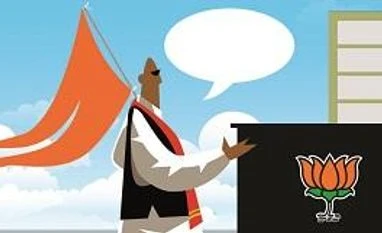
Illustration: Binay Sinha
The BJP’s core value appears to be nationalism but it is again not easy to fathom how this is to be expressed or what flag-waving and slogan-shouting are intended to achieve. Its assumption is that the individual’s relationship to the State is the same as their relation to the nation. For this reason, the party steers clear of those parts of the Constitution where the rights of the individual are enshrined. This is because the party sees this as encroachment on the rights of the State and by extension of the nation. Article 19, which initially gave us almost unrestricted freedom of speech, peaceful assembly and association, has come under sustained attack from the BJP, which has, more than the Congress, asserted the right of the State to block the exercise of these freedoms. The pushing of the non-justiciable and meaningless “fundamental duties” also ensues from this same pattern of unformed ideological energy. When in control of the State, for the most part the BJP’s leaders tend to speak in the rough languge of its supporters, to communicate the strength of the emotion they feel for minority Indians.
A different facet of their majoritarian nature is the BJP’s conviction that democracy is comprised of elections. The higher aspects of democracy, meaning the ability of individuals to enjoy freedoms, are alien to its thinking and when in authority shows itself in the BJP’s suspicion and dislike of civil liberties and refusal to concede the State’s right to “reasonable classification” and “reasonable restriction”.
The laws that the BJP has gifted us after 2014, which criminalise beef, prohibit interfaith marriage, restrict access to citizenship for Muslims and have gutted Kashmir’s fictional autonomy, are shot through with a certain churlishness and pettiness. However, they do not speak to any political theory and are not intended to achieve anything other than push exclusion and inflict humiliation and suffering. Some of the party’s more eccentric members, like Subramanian Swamy, have proposed disenfranchising Indian Muslims, but this has not been received positively even inside the Sangh Parivar.
These are some of the inchoate elements that define India’s ruling party’s outlook and ideology. Because Hindutva is quite rustic, and has no structural or formal elements, it can exist within the current Constitution and the BJP has no desire to alter it. That also suggests that it is possible, and in time perhaps inevitable, that Hindutva will expend itself and the underlying pluralist and liberal nature of the Constitution and of our country will again shine through.
The writer is chair of Amnesty International India
Disclaimer: These are personal views of the writer. They do not necessarily reflect the opinion of www.business-standard.com or the Business Standard newspaper




