Indian Railway (IR) coaches will look better, inside and outside. Thirty thousand ICF (Integral Coach Factory) coaches will be coloured beige and brown, the first being the Delhi-Pathankot Express (22429). No one pays much attention to the exterior, the livery, of rolling stock – locomotives, wagons and coaches. Understandably, passenger comfort is about the inside, not the outside. Many years ago, all coaches used to be dull maroon, the colour of rust. One still sees them here and there, on trains less than special. Then IR switched from vacuum brakes to air brakes, the latter being superior. ICF coaches with air brakes started to have blue livery. But note, ICF coaches are also less than special. Special trains are those with LHB coaches. So far as the livery of passenger coaches is concerned, there are three grades; (a) dull maroon/rust; (b) blue; and (c) special trains. Special trains, and this extends beyond Rajdhani/Shatabdi, have had many kinds of livery, deviating from the maroon/rust or blue hue. This makes them colourful and not subject to standardisation. There is no reason why that colour shouldn’t include advertisements, outside and inside bogies. This is a means for increasing non-fare revenue. Indeed, the policy permits this. However, media rights are easier to sell if they are offered for the entire rake and not just individual coaches. Often, because of shortages, rakes are formed by jumbling coaches together, especially on less than special trains. They aren’t fixed rakes and media rights are harder to sell then.
A maroon/rust coach is older than a blue coach. One can glean something about age from numbering of a coach too. But because numbering isn’t standardised, this isn’t precise. This may be a reason why people don’t pay as much attention to numbering of coaches as they do to numbering of locomotives. Or perhaps people are simply more interested in locomotives. Depending on vintage, a coach will have four, five or six digits in its number. I suspect most will have at least five digits now. With a couple of caveats, the first two digits should indicate the year when the coach was built. The caveats are — it may not represent the year of manufacture, but may indicate the year it was transferred to the zone that owns the coach; it may not represent year of manufacture, but the year when the coach was rebuilt, if that happened. For instance, a coach from New Delhi-Dehradun Shatabdi Express is numbered 04901. In all probability, that coach was manufactured in 2004. What about 901? IR people will correct me. I think this indicates this was the 901st coach (of this type) received by the zone (in this case Northern Railway).
Illustration by Binay Sinha
A bizarre news report appeared a few days ago. According to this, coaches from trains between New Delhi and Ranchi (Rajdhani, Sampark Kranti) have gone missing from the yard. Thieves can steal smaller items. How can thieves steal entire coaches without IR knowing it? What was RPF (Railway Protection Force) doing? The rake for 12826 Jharkhand Sampark Kranti Express is owned by South Eastern Railway (SER). The rake for 20839 Ranchi-New Delhi Rajdhani Express is also owned by SER. 12826 has ICF coaches and is not a fixed rake. 20839 has LHB coaches. But I suspect even this is not a fixed rake. It isn’t one of the major Rajdhanis, where rakes are usually fixed. SER has four divisions, one of which is the Ranchi Division. (The others are Adra, Chakradharpur and Kharagpur). Since these coaches were not headed towards Santragachi for maintenance (that is SER’s maintenance yard), they must have been with Ranchi Division, waiting to be fixed to 12826 or 20839. More specifically, out of Ranchi Division’s major yards in Muri, Ranchi and Hatia, they must have been in the Ranchi yard itself. To rephrase the question, how can gangs steal coaches from a yard within Ranchi? This bizarre news report was simply inaccurate. No coaches had been stolen or lost. These are trains between New Delhi and Ranchi, SER at one end and Northern Railway (NR) at the other. Instead of being parked in SER’s yards, the missing coaches were parked in NR’s yards.
There are reverse trains too. For instance, there is the 20840 New Delhi-Ranchi Rajdhani, a rake owned by NR. Coaches from 20839 had been hooked on to 20840, intentionally or unintentionally. 12825/12826, from Ranchi to Anand Vihar and in the reverse direction, might have been a slightly different case. Both rakes are owned by SER and there is no question of NR appropriating coaches. With multiple marshalling yards in Delhi, coaches could have got misplaced. Nevertheless, there is a broader point that should still be made. That news about gangs stealing coaches from Ranchi appeared in a variety of places. I am not aware of this having been contradicted by IR — from Delhi, SER or Ranchi division — at least not formally and properly. Therefore, in popular perception, that bit of fake news registers an impression. PR and media management has never been IR’s strong suit, though it has improved. For instance, the four-year-documentbrought out by the Railways is excellent. The cover has Mahatma Gandhi descending from a train and the number of the coach is a four-digit 3985 (this is a painting by Shyam Sundar Acharya). The most famous image of Gandhiji descending from a train in India (not South Africa) is probably Motihari. Is that 3985 numbering correct? I have no idea.
The author is chairman, Economic Advisory Council to the Prime Minister.
Views are personal

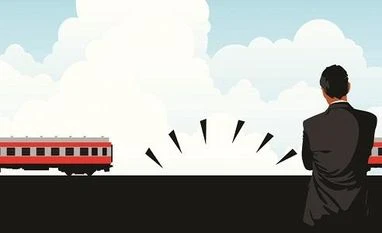 "Coaches and numbers")












 Connect with us on WhatsApp