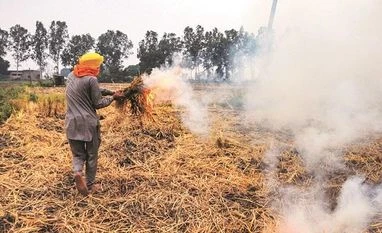
The Delhi government’s recent announcement about working on a plan to bring down air pollution due to the burning of crop residues in the capital’s neighbourhood is a welcome move that should spur similar action by the governments of the adjoining states as well. The drive against torching paddy stubble in north-western states seems to have overcome the initial hiccups and has started to show results. The Indian Council of Agricultural Research recently claimed, on the basis of satellite-based studies, that the incidence of biomass burning had dipped last year by 41 per cent in Haryana, 25 per cent in western Uttar Pradesh, and 15 per cent in Punjab over 2017. This is a small, yet significant, beginning. However, much more needs to be done to ensure enduring results.
A key flaw in the present anti-stubble burning strategy of the Centre and states is that it is focused primarily on promoting the use of Happy Seeder, a tractor-mounted machine that cuts the paddy straw and sows the next wheat crop in a single operation. Regardless of the merits of Happy Seeder, a one-pronged and single appliance-based tactic to tackle this menace cannot be free from downsides. This is an expensive machine, which most farmers cannot buy despite a hefty 50 per cent subsidy. Though a higher concession of 80 per cent is offered to the cooperatives and farmers’ producer organisations to procure these machines for custom-hire services, their limited period use — just around three weeks in a year — does not amply justify large investments in them. Besides, this can be operated only with a high horse-power tractor, which most cultivators do not possess. Moreover, many farmers hesitate to spend on managing the stubble — even though the expenses are recompensed later through higher crop yields — when the same can be done free of cost by torching the fields.
Clearly, stubble burning is an economic issue that requires an economically rewarding solution. The need is to add value to paddy leftovers to make them a marketable economic good. The farmers would not mind spending on collecting the residues if they can earn something from them. Unlike wheat straw, which fetches handsome prices because of its use as animal feed, paddy stalks are unfit for this purpose due to high content of indigestible silica. So, other avenues need to be discovered for their gainful use. Luckily, technologies are now emerging to convert paddy biomass into fuel pellets and bricks. It can also generate bio-gas or other forms of bio-energy. Oil companies, such as Indian Oil Corporation and Hindustan Petroleum, are setting up plants in Punjab to produce bio-CNG from paddy wastes. They may need assistance in developing the logistics infrastructure for procuring and transporting the biomass.
This apart, efforts need to be stepped up to find bio-agents for speedy decomposition of crop residues to make valuable composts. Some successes have already been reported in this field, which should promptly be validated and promoted. A fresh opportunity has now emerged for using paddy straws in the packaging sector, which is the largest user of the now banned single-use plastic. Like in the past, paddy straws can serve as the cushion for packing fragile products, replacing thermocol and other plastic material. Such approaches can transform the baneful crop waste into useful wealth.

 "Combating air pollution")












 Connect with us on WhatsApp