Economy looks set for a rebound

Budget hopes, strong FPI inflows have kept the markets buzzing. Things may turn if the Budget disappoints
graph
Devangshu Datta
Last Updated : Jan 22 2018 | 10:39 PM IST
The Indian economy seems set for a rebound in growth prospects but there are worries on the fiscal consolidation front and inflation could be a concern going forward. As the Republic Day settlement beckons, it would be all eyes on the Budget which is less than a fortnight away. There are many conflicting rumours about possible tax changes in the GST and the Budget. 

Corporate results indicate that the economic rebound continued and broadened through Q3 (October-December 2017). Market leaders like HDFC Bank, Reliance Industries and Hindustan Unilever all beat consensus expectations. Infosys saw profits jumping, due to an one-off accounting adjustment but it also maintained its 2018 forecast. 

HUL registered 28 per cent growth in net profit (NP) for the quarter. HDFC Bank announced year-on-year growth of 20 per cent and market capitalisation crossed the Rs 5 trillion mark. But NPAs rose 57 per cent with the RBI logging over Rs 20 billion in reporting divergences. Provisioning was lower. Infosys registered 37.5 per cent growth in NP but about Rs 14.30 billion ($225 million) came from the reversal of tax provisions. Without that, profits would have been more or less flat but Infy maintained its guidance. TCS more or less met market expectations as well. 

RIL registered an awesome 25 per cent growth in NP. Gross refining margins continued to rise boosting the main refining and petrochem segments, and the telecom subsidiary Reliance Jio Infocomm registered Rs 5.04 billion in maiden net profits. 

Inflation numbers showed some divergence between the Wholesale Price Index and the Consumer Price Index (CPI). The WPI moderated at 3.58 per cent year-on-year in December versus 3.93 per cent YoY in November. The CPI rose to 5.21 per cent in December versus 4.88 per cent in November. Since the CPI is the RBI’s benchmark, the February Monetary Policy Review is very unlikely to see a cut in policy rates. The lower WPI does suggest that manufacturers still lack purchasing power. There is a chance that lower wholesale food prices will translate into lower inflation in the retail food basket going forward and that could mean lower CPI in January-February.


The other problem area for inflation is fuels. Crude prices are up to uncomfortable levels. The Indian crude basket hit $62 plus per barrel in December and it's likely to be a bit higher in January. January 2017 prices were at $54/ barrel. OPEC estimates suggest that global crude inventories are being rapidly depleted and that could mean higher prices through 2018.

Higher crude prices not only put pressure on the Trade Balance; these also put a question mark on the central government’s ability to maintain the current excise duties and (state) sales tax imposts on retail fuels. High pump prices could feed inflation and cause political dissatisfaction as well. 
 
The Budget could see some sort of change in the treatment of long term capital gains (LTCG) from equity and equity mutual funds. It could also see some changes, or even the outright elimination of, Dividend Distribution Tax and the Securities Transaction Tax, if there is a tax imposed on LTCG.  Apart from that, there’s talk of a possible cut in corporate tax rates. 

Given that the GST is still unstable, indirect tax collections will see a shortfall and the fiscal deficit will rise by some amount beyond the February 2017 Budget target of 3.2 per cent of GDP. The government will exceed its borrowing target in 2017-18 but only by Rs 200 billion instead of the Rs 500 billion that was initially feared. The market will watch the 2018-19 Budget targets for the fiscal deficit like a hawk. That number is as critical as the growth assumptions. 

Bond-market watchers are worriedly tracking the yield curve for government bonds. The differential between short-tenure treasuries and the 10-year bond have narrowed considerably and the yields have also risen. This is a consequence of higher government borrowing which will crowd out private debt raising to some extent. But a flat yield curve is also often an early warning signal of an economic downturn though that's hard to believe. 

The entire global economy is likely to do well in 2018. China's GDP data for the last quarter shows the highest growth acceleration since 2010. That gels with higher growth across the EU, Japan and USA. The rising tide should also drive the Indian economy. It will inevitably mean tighter monetary conditions however, as the US Federal Reserve unwids its balance sheet and hikes rates while the European Central Bank and the Bank of Japan start to cut back on QE programmes. In fact, yields are rising across most major world currencies. The USD has also lost an enormous amount of ground in the last year.
 
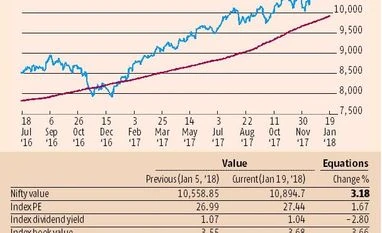
This is one of those rare periods when domestic and foreign institutions as well as retail are all net bullish. As of now, good corporate results, high hopes from the Budget and strong foreign portfolio investment inflows have kept the market buzzing, with a sequence of successive record highs. The Nifty has climbed more than 4 per cent since the New Year. It’s very likely to cross 11,000 by Budget-day. Valuations are also at historically high levels. If the Budget disappoints, be braced for an equally sharp correction. 

One subscription. Two world-class reads.

Already subscribed? Log in

Subscribe to read the full story →
*Subscribe to Business Standard digital and get complimentary access to The New York Times

Smart Quarterly

₹900

3 Months

₹300/Month

SAVE 25%

Smart Essential

₹2,700

1 Year

₹225/Month

SAVE 46%
*Complimentary New York Times access for the 2nd year will be given after 12 months

Super Saver

₹3,900

2 Years

₹162/Month

Subscribe

Renews automatically, cancel anytime

Here’s what’s included in our digital subscription plans

Exclusive premium stories online

  • Over 30 premium stories daily, handpicked by our editors

Complimentary Access to The New York Times

  • News, Games, Cooking, Audio, Wirecutter & The Athletic

Business Standard Epaper

  • Digital replica of our daily newspaper — with options to read, save, and share

Curated Newsletters

  • Insights on markets, finance, politics, tech, and more delivered to your inbox

Market Analysis & Investment Insights

  • In-depth market analysis & insights with access to The Smart Investor

Archives

  • Repository of articles and publications dating back to 1997

Ad-free Reading

  • Uninterrupted reading experience with no advertisements

Seamless Access Across All Devices

  • Access Business Standard across devices — mobile, tablet, or PC, via web or app

More From This Section

Disclaimer: These are personal views of the writer. They do not necessarily reflect the opinion of www.business-standard.com or the Business Standard newspaper
Next Story



