Increasing infection

Govt should not get complacent about Covid management
Coronavirus, Covid, vaccine
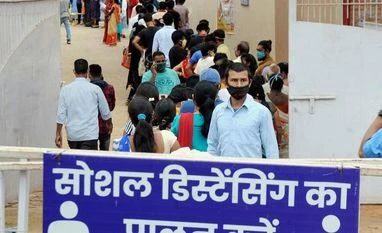
Beneficiaries wait in a queue to receive Covid-19 vaccine dose, at Birsa Munda Football stadium in Ranchi | Photo: PTI
Business Standard Editorial Comment New Delhi
3 min read Last Updated : Jul 22 2021 | 12:10 AM IST
India has not emerged from the threat of the pandemic and the threat of a third or even a fourth wave hovering over everybody. The distribution and intensity of a third wave will depend not just on vaccination rates but also on how the first and the second wave have played out. It is unfortunate, therefore, that the government has not worked hard enough to get reliable data on the spread of the virus and its effect on mortality. What is available is the Indian Council of Medical Research’s (ICMR’s) series of serosurveys, which sample the prevalence of antibodies for Covid-19 in the country. Headline data from the most recent round, the fourth, was released this week. ICMR surveys about 29,000 respondents in 700 villages and wards, from 70 districts in 21 states. The three previous serosurveys have seen an increasing incidence of antibodies among the respondents — from 0.73 per cent in May and June last year, to 7.1 per cent during August and September of 2020 and then 24.1 per cent in December and January. The fourth round, conducted in June and July, saw the seroprevalence after the second wave jump to 67.6 per cent. In other words, two-thirds of the respondents had antibodies to Covid-19, indicating they had been exposed to the disease or to the vaccine. That one-third are still without antibodies suggests that a third wave can potentially infect a lot of Indians. It would be unwise to expect that “herd immunity” thresholds are close to being reached as the delta variant, being more infectious, has significantly raised that threshold. So without a proper near-universal vaccination, herd immunity may be impossible.

The government must analyse this data carefully, particularly if it can be subdivided geographically using other demographic markers without losing too much statistical significance. For example, which states have higher levels of seroprevalence? Where might a breakout cause the greatest level of mortality? But the government cannot assume either that seroprevalence at this level provides an equal level of protection to all those with antibodies. Breakthrough infections — in which those with antibodies nevertheless get the disease — are not as rare with the delta variant as with the original variant of Covid-19. Repeat infections are certainly possible; even some of those who have been vaccinated may develop symptomatic infection, though data suggests the vaccines are nevertheless effective at preventing severe disease.

In order to properly predict the future of the disease, the government must understand its past. And serosurveys are just one tool. Another, even more effective tool might be to develop a proper estimation of the mortality rates in the previous waves. Here the government’s efforts have fallen short. Recent work by a group of economists that includes former chief economic advisor Arvind Subramanian has come up with estimates of deaths from Covid-19 using three different methods. These estimates — which correspond to an infection rate in June of 65 per cent, precisely what the serosurvey indicates — suggest that 3.4 to 4.9 million Indians may have died so far in the pandemic, an estimate that is way beyond the official numbers. Outrageous claims that no deaths were reported due to oxygen shortages will not help protect India from future waves. The government must work to improve the data that informs its policy on the pandemic.


One subscription. Two world-class reads.

Already subscribed? Log in

Subscribe to read the full story →
*Subscribe to Business Standard digital and get complimentary access to The New York Times

Smart Quarterly

₹900

3 Months

₹300/Month

SAVE 25%

Smart Essential

₹2,700

1 Year

₹225/Month

SAVE 46%
*Complimentary New York Times access for the 2nd year will be given after 12 months

Super Saver

₹3,900

2 Years

₹162/Month

Subscribe

Renews automatically, cancel anytime

Here’s what’s included in our digital subscription plans

Exclusive premium stories online

  • Over 30 premium stories daily, handpicked by our editors

Complimentary Access to The New York Times

  • News, Games, Cooking, Audio, Wirecutter & The Athletic

Business Standard Epaper

  • Digital replica of our daily newspaper — with options to read, save, and share

Curated Newsletters

  • Insights on markets, finance, politics, tech, and more delivered to your inbox

Market Analysis & Investment Insights

  • In-depth market analysis & insights with access to The Smart Investor

Archives

  • Repository of articles and publications dating back to 1997

Ad-free Reading

  • Uninterrupted reading experience with no advertisements

Seamless Access Across All Devices

  • Access Business Standard across devices — mobile, tablet, or PC, via web or app

Topics :CoronavirusVaccinationCoronavirus VaccineICMR

Next Story



