What Modi and Shah tried to pull off in Maharashtra is absolutely fine

The drama in Maharashtra shows no party is better than the BJP at using the existing ethical framework for political advantage
politics
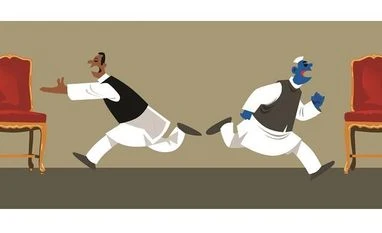
Illustration by Binay Sinha
Aakar Patel New Delhi
5 min read Last Updated : Jan 08 2020 | 10:47 PM IST
When a party controls both the governor’s office and the legislature in the United States, it redraws the borders of constituencies. Neighbourhoods where supporters are in greater number are broken up (or clubbed together) to ensure that the party retains a majority in as many electoral districts as possible.

Opponents — whether working class, white collar, African American, Latino or any other unwanted class — are again either broken up or clubbed together to ensure maximum advantage. And data in America is very good, both in terms of identifying economic as well as social groups and neighbourhoods. So it is not difficult to pick out and then isolate or club voters. This American practice is over 200 years old and is called gerrymandering after the man who thought it up. It results in new constituencies with grotesque shapes totally removed from natural geography or logic.

It sounds wrong and immoral and smells of gamesmanship if not outright electoral fraud. Someone described it as a politician picking his voters instead of voters picking the politician. And that is quite right. But it is legal, and in America both parties indulge in gerrymandering. The media and some voters whine about it, and there are some restrictions that have been placed on it by the courts but it is acceptable and, therefore, it is used to the maximum by political parties.

Events in Maharashtra show that of all our political forces, there is none that is better than the Bharatiya Janata Party (BJP) at using the existing ethical framework to push for advantage. It is difficult for the neutral observer to not stand back and admire the drive, the resolve and the energy that India’s two most powerful men bring to their work. The fact that they failed in Maharashtra is to my mind unimportant. It is the hunger and enthusiasm of the prime minister and the BJP president for winning that stands out as one of the revelations of these recent events. 

Illustration by Binay Sinha
The Congress party complained about the President being woken up at 4 am to rubber-stamp Prime Minister Narendra Modi’s and BJP president Amit Shah’s instructions to him. But it was not unlawful. The governor was ordered to swear in the patch-up government while many of us were still asleep — but again this was not unlawful. Nor was it either illegal or wrong for the BJP to try and aggressively go after legislators from the other side. This is what all parties do, and I do not know of a party that was punished by the voter for this because there is no such party and no such voter.

The fact is that the Indian ethics allow for free transfer of political loyalty. The turncoat is a rare phenomenon in American and British politics but a common one in India. Such a person was given an Indian term, “Aaya Ram”. This was checked by another Indian innovation, the anti-defection law, but this law is fundamentally undemocratic. It has totally stopped the possibility of internal dissent and votes of conscience. It has also made possible, though this is less important, wholesale defections — such as the one Ajit Pawar was entrusted with — instead of retail ones.

India’s Supreme Court, as has been its wont, offered to be the guardian of morality in Maharashtra. It ordered a vote and said: “To curtail unlawful practices such as horse-trading, to avoid uncertainty and to effectuate smooth running of democracy by ensuring a stable government, we are of the considered opinion that it is necessary to pass certain interim directions in this case.”

The fact is that horse-trading (this term is wrongly used in India but that is a separate matter) is not unlawful, and that is the judgment of the Jharkhand Mukti Morcha bribery case in Parliament. There it was decided that the receipt by legislators of a bribe for actions inside the legislature, such as for a vote of confidence, was not a crime. When this is so, certainly the offer of ministerial posts and chairmanships of various bodies, which are not bribery, are acceptable and should not be viewed as “unlawful practices”. 

This is fully understood by Mr Modi and Mr Shah. I do not think that they are embarrassed or ashamed of either what they tried to pull off, or indeed the way it turned out. They played the game by the political rules and social mores of India and they lost, but only because the numbers were against them in this instance. 

There is no point in our bleating about how this is not democratic or ethical because that is an appeal to abstract standards. Indian democracy is built on a foundation and on principles that have become identifiably Indian. 

The most visible evidence of this is that our Lok Sabha does not resemble the body that it is meant to copy, the House of Commons. In the Indian legislature, there is not much legislating, there is little decorum, protocol is quite often and perhaps even most often not observed, the quality of debate is shockingly poor, and points are made by disruption more often than by rhetoric. But that is the way it is and the Lok Sabha is a reflection of Indian society. We mustn’t expect it to be the House of Commons, because we are not English.

We must judge our leaders by our standards and if we were to do so, what Mr Modi and Mr Shah did in Maharashtra is absolutely fine. That they failed to pull it off is the only thing that can be held against them but that, as I said, is unimportant. 
Another opportunity will come again soon. And the two men will bring the same skills and drive that were on display and which, no matter which side one takes, must be admired. 

One subscription. Two world-class reads.

Already subscribed? Log in

Subscribe to read the full story →
*Subscribe to Business Standard digital and get complimentary access to The New York Times

Smart Quarterly

₹900

3 Months

₹300/Month

SAVE 25%

Smart Essential

₹2,700

1 Year

₹225/Month

SAVE 46%
*Complimentary New York Times access for the 2nd year will be given after 12 months

Super Saver

₹3,900

2 Years

₹162/Month

Subscribe

Renews automatically, cancel anytime

Here’s what’s included in our digital subscription plans

Exclusive premium stories online

  • Over 30 premium stories daily, handpicked by our editors

Complimentary Access to The New York Times

  • News, Games, Cooking, Audio, Wirecutter & The Athletic

Business Standard Epaper

  • Digital replica of our daily newspaper — with options to read, save, and share

Curated Newsletters

  • Insights on markets, finance, politics, tech, and more delivered to your inbox

Market Analysis & Investment Insights

  • In-depth market analysis & insights with access to The Smart Investor

Archives

  • Repository of articles and publications dating back to 1997

Ad-free Reading

  • Uninterrupted reading experience with no advertisements

Seamless Access Across All Devices

  • Access Business Standard across devices — mobile, tablet, or PC, via web or app

More From This Section

Disclaimer: These are personal views of the writer. They do not necessarily reflect the opinion of www.business-standard.com or the Business Standard newspaper

Topics :Amit ShahMaharashtra Assembly ElectionsMaharashtra governmentDevendra Fadnavisajit pawarUddhav ThackeraySonia GandhiBJPLok Sabha elections 2019Supreme Court

Next Story



