The lad may have been privileged to boot, but he was certainly a very clever Etonian. Having done excellently in his O-level exams, he secured top grades for his three A-level papers and then passed the Oxford entrance exam with high enough marks to secure an exhibition scholarship for studying Philosophy, Politics and Economics (PPE) at Brasenose College. And for all his upper-class university club memberships — including the infamous Bullingdon Club, known for its wealthy black-tie members, brash, drink sodden dinners and wanton destruction of crockery — the young man smoothly sailed through his PPE getting a first class honours degree. If you look carefully across his subsequent career as a Tory MP culminating in being the prime minister of the United Kingdom of Great Britain and Northern Ireland from May 2010 to his resignation in July 2016, David Cameron hardly ever took a wrong step. Except a single fatal one.
Having promised in the 2015 election campaign to renegotiate a European Union (EU) deal that would be more favourable to Britain, Cameron tried his hand with the Commission in Brussels after securing a solid majority in the House of Commons. Brussels rebuffed him on the things that mattered. So Cameron decided to up the ante by opting for a stay-or-leave EU referendum on June 23, 2016, supremely confident that the vast majority of Britons would vote to remain.
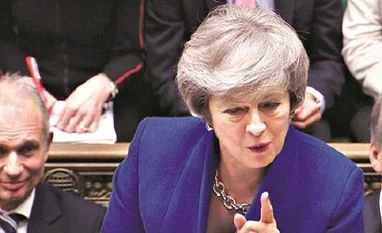
ROYAL MESS: If Theresa May wins the vote of confidence, she has a very tiny window to re-fashion her Brexit proposal
Cameron was so sure of the outcome that the ballot for such a momentous decision was but a simplistic little document. It asked a one-sentence question: “Should the United Kingdom remain a member of the EU or leave the EU?” with the instruction to cross one of the two boxes — one to remain in the EU, and the other to leave. Why must it be complicated, Cameron believed, when the vast majority would obviously vote to remain?
That didn’t happen. Over 17.4 million citizens across Britain, or almost 52 per cent, voted to leave. Scotland, Greater London and Northern Ireland voted to remain, but that didn’t count in the final adding up. After getting Theresa May to take over as the next prime minister, Cameron quit both his premiership and his constituency.
‘Inept’ and ‘hapless’ are probably the two words that best describe May’s stint at 10 Downing Street. Inept because when faced with rebels within her party such as Boris Johnson, Iain Duncan Smith, Dominic Raab, Jacob Rees-Mogg and many others, she singularly failed to convince them that her Brexit deal was worth voting for. Hapless because she called for an ill-fated mid-term general election in 2017 which, instead of strengthening her hold in the House of Commons, reduced her to a minority government surviving on an unholy alliance with the Democratic Unionist Part of Northern Ireland. Equally hapless because the 2017 election gave the Labour 262 seats — 30 more than earlier — and put its intensely anti-Tory leader, Jeremy Corbyn, in a more powerful position than before.
After over 200 speeches spanning eight days of debate in the Commons, when May’s Brexit scheme came up for voting on 15 January 2019, many believed she might lose, but by a whisker. That wasn’t to be. May’s Brexit plan was shot down by a massive margin of 230 votes: 202 in favour versus 432 opposed. In what was a huge embarrassment for the beleaguered PM, 118 Tory MPs cross-voted against their leader’s proposal — something that hasn’t happened in the Commons for several decades.
What next? As expected, after this huge loss, Corbyn, as the leader of the Opposition, put forward a vote of no confidence, which was debated and voted upon on 16 January. Theresa May ought to wriggle out of that one, because no Tory MP wants another general election right now. But in today’s Britain, who can tell?
If Corbyn prevails and the House expresses no confidence in the present government, then there will be another general election in another 60 to 90 days. All re-working of the Brexit strategy will go out of the window, as each MP scrambles to his constituency to garner votes.
If, however, the PM wins the vote of confidence, she has a very tiny window of opportunity to re-fashion her Brexit proposal, make it more palatable for her party, and try and sell it yet again in the Commons. It will be a herculean task. May is badly bruised, has lost all her wits and negotiating skills — of which she had little to start with — and is looking like a loser with whom few wish to talk and to whom none of the recalcitrant MPs wish to submit.
Only one thing is certain. The UK will have to quit the EU on March 29, 2019, a mere 73 days away. And as yet, not a soul in that country has a clue what that exit will be: Ultra-hard, hard enough, hard-with-soft edges, soft-with-hard edges, or anything in between.
It is a right royal mess of the kind that Great Britain hasn’t seen for a very long time. Not only has Theresa May become a colossal political embarrassment, but also the country’s politicians are looking at best stupid, and at worst self-serving. Jeremy Corbyn couldn’t care less if everything fails. He has a single point agenda: Of his becoming the next PM with a Labour government in power. And the agenda for over 37 per cent of the Tory MPs is to shaft their PM, devil take the hindmost.
Great Britain is now looking so stupid that one can easily remove the lofty adjective to the proper noun. I had never thought of Brussels’ briefcase-toters as worthy politicians. Yet today, they look like statesmen who are saying, “We didn’t initiate this. You did. So why can’t you fix it?” It will need a profound miracle for Little Britain to do what is so desperately needed. If it at all can. The tea leaves look terrible.
The author is an economist and chairman of CERG Advisory Private Ltd