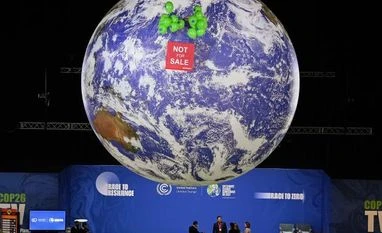
The final text of the Glasgow Agreement, hammered out at the recently concluded 26th Conference of Parties under the UNFCCC (United Nations Framework Convention on Climate Change), was the first to specifically acknowledge the need to move away from dependence on coal-fired power in order to reduce the emission of greenhouse gases. However, the language in the final text was considerably weaker than originally proposed. In particular, instead of committing to moving towards “phasing out” coal, the text only requires countries to “phase down”. This is correctly being seen as broadly insufficient. What is worse, however, is that India is being seen as the cause of this weakening of the text. This is a sub-optimal outcome, and the negotiating team must be considered accountable.
It is unclear why a commitment to phasing out coal is not reconcilable with India’ existing targets. It is true that the Indian power generation mix will continue to have coal, including new resources, until 2030 and beyond. Yet India is not alone in doing so, and its next target has been set for 2070, when technologies will have changed in as yet unknowable ways. Indian negotiators might justifiably complain that the focus on coal allows big fossil fuel users — including users of oil and gas, such as the United States and the European Union — to escape scrutiny. They might also point out that phasing out coal can and must depend upon the greater mobilisation of climate finance to bridge the viability gap for new non-coal projects. Yet none of that addresses the central question of why India chose to lead the opposition to the “phase out” language for coal in the first place. The wording, as originally planned, would not have set constraints on planned Indian action in the sector.
A perennial problem in Indian efforts at COPs in the past has been its tendency to provide cover for China. The latter has by far the highest per capita coal consumption among major global economies. It has commissioned dozens of new coal-fired power plants in 2021 alone. Even the “phase down” wording is identical to its official pronouncements in the past regarding its use of coal, and to the wording in the US-China joint declaration on climate action released earlier during COP26. In other words, New Delhi allowed itself to play the bad guy and willy-nilly defend Beijing’s policy choices. This must be explained, especially as it has the potential to cause a serious rupture between India and the small island nations and least developed economies, whose interests India has claimed to support in the past. Once again, it looks like Indian negotiators have been played by their Chinese equivalents.

 "Played again")












 Connect with us on WhatsApp