Polytheism vs monotheism

Secular Europe today faces the same form of extremism that the pagan Roman emperors faced in the early years of the Christian era
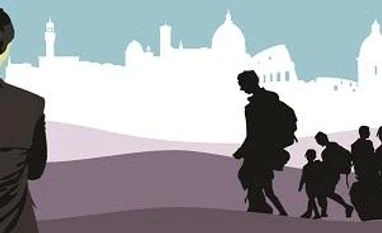
Illustration by Binay Sinha
Deepak Lal
Last Updated : Aug 29 2018 | 11:19 PM IST
Since the mid-1980s we used to holiday on the beaches of the Mediterranean in France, Spain and Italy, but over the last 10 years as the influx of migrants from the Middle East and North Africa has accelerated, including many jihadists who are ramming trucks and cars into the pedestrians on the sidewalks on the beaches whilst others are stabbing bathers, we have eschewed these locations, particularly as with advancing age we can no longer run away from such threats. So, this year we decided to spend a week in a beach resort in Split in Croatia. As the Adriatic is still free of these predators, and the beaches are still relatively uncrowded, this turned out to be an excellent choice. Not least because of the monuments left by the various empires which have controlled the area over the millennia, many of which have been used to film the marvellous TV series Game of Thrones of which I remain an addict.

Split is built around the surprisingly well-preserved palace of the Roman emperor Diocletian (244-311 AD), constructed between 295 and 305 AD as his retirement abode once he became the only Roman emperor to have abdicated, after a 20 year reign (284-305 AD). Edward Gibbon in his Decline and Fall of the Roman Empire (Folio edition, vol. II) notes “Like Augustus, Diocletian may be considered as the founder of a new empire. Like the adopted son of Caesar, he was distinguished as a statesman rather than as a warrior, nor did either of these princes employ force, whenever their purpose could be effected by policy”. (p.22) His bureaucratic, and fiscal reforms “fundamentally changed the structure of Roman imperial government and helped stabilize the empire economically and militarily, enabling the empire to remain essentially intact for another 150 years despite being near the brink of collapse in Diocletian’s youth” (https:/en.wikipedia.org/wiki/Diocletian). 

Diocletian also instituted the empire’s last, largest and official persecution of Christians (303-11 AD). This failed to eliminate Christianity. Instead within a few years after his death, Christianity became the empire’s preferred religion, with the accession of the first Christian emperor Constantine in 342 AD. It is the resonance of this European past between the struggle of the polytheism of the Graeco-Roman world and the monotheism of the new sect of Christians, and the present battle between a largely secular and pagan Europe and its imported sectarians of Islam, which retains contemporary interest. 

The pagans of Rome as polytheists had tolerated the monotheist Jews in the empire, for as Gibbon notes, “according to the maxims of universal toleration, the Romans protected a superstition they despised.” (p.95). As the Jews did not proselytise, and given the universal pagan aversion to their habits, in particular “the painful and dangerous rite of circumcision was alone capable of repelling a willing proselyte from the door of the synagogue” (p.97), they were not viewed as a threat. More aver, unlike their deviant sect of Christianity but like the pagans “the doctrine of the immorality of the soul is omitted in the law of Moses… the hopes as well as fears of the Jews appear to have been confined within the narrow compass of the present life”. Pauline Christianity by contrast emphasised the immorality of the soul and its salvation by conversion to Christianity. By claiming to be a universal religion actively seeking converts and openly defying the idolatrous conventions of paganism, it presented a threat (unlike Judaism) to civil order, amplified by its reliance on martyrs to promote its cause. 

Illustration by Binay Sinha
The reason why the Christians, unlike the Jews, were persecuted says Gibbon was “according to the sentiments of antiquity simple and obvious… the Jews were a nation, the Christians were a sect: and if it was natural for every community to respect the sacred institutions of their neighbours, it was incumbent on them to persevere in those of their ancestors….By embracing the faith of the Gospel the Christians incurred the supposed guilt of an unnatural and unpardonable offence. They dissolved the sacred ties of custom and education, violated the religious institutions of their country, and presumptuously despised whatever their fathers had believed as true or had reverenced as sacred…”(p.150). He concludes, for the pagans “it was no less a matter of surprise that any individual should entertain scruples against complying with the established mode of worship than if they had conceived a sudden abhorrence to the manners, the dress, or the language of their native country” (p.151).

In its earliest phase “Christianity’s most public advertisement was martyrdom”, Robin Lane Fox informs us is his Pagans and Christians. Some of the pagan spectators could have had second thoughts “wondering what was this ‘atheism’ for which such old and harmless people faced death, girls and women among them”, which could have led to their conversion. But equally important was the early church’s idealisation of Christians’ death as martyrdoms, ‘second baptisms’ which effaced all previous sins and ensured an immediate crown in paradise. These martyrdoms were very public events: A form of public entertainment where the Christian ‘criminals’— including many well-born women were “pitched into the cities arenas for unarmed combat with gladiators or bulls, leopards and the dreaded bears”. This ideal of martyrdom persists to our day. “From the Christians early Islam picked up its analogous language and theology for those who die for their faith. Dreams of a martyr’s glory impel boys to volunteer, as Christians once volunteered for trial. They risk gassing and chemical burns, the modern heirs of the fires and wild beasts” (Ps 419-20).

An increasingly secular Europe, where the ferocity and intolerance of Christianity has been tamed by the gradual acceptance of Enlightenment values, looks more and more like the pagan world of yore. But, as Douglas Murray has pointed out in an important book (The Strange Death of Europe), it is now threatened by the mass migration of followers of Islam in recent years from the greater Middle East and North Africa. As many of these migrants have Salafis amongst their midst, whose aim is to extend their medieval monotheistic beliefs in their new homeland, an avowedly religiously tolerant Europe is now faced by the same form of extremism — including jihadi martyrs of a monotheist religion — that the pagan Roman emperors faced in the early years of the Christian era. Will Europe’s citizens, increasingly worried by the violence and depredations of people with different values that threaten to change their homelands, force their politicians to undertake the persecutions of these foreign monotheists, or will the tolerance of these alien values lead to the conversion of their polities (as under Constantine) to the hitherto alien faith? This latter prospect has been brilliantly painted in the young French novelist Michel Houellebecq’s book Submission. Whilst the revolt of Eastern European countries, Austria and Italy against German Chancellor Merkel’s open door to a million migrants, and the rise of anti-immigration parties in Sweden, Denmark and Holland portends the likelihood of the former route to dealing with the contemporary clash between the pagans and monotheists in Europe, we will have to wait and see. 

One subscription. Two world-class reads.

Already subscribed? Log in

Subscribe to read the full story →
*Subscribe to Business Standard digital and get complimentary access to The New York Times

Smart Quarterly

₹900

3 Months

₹300/Month

SAVE 25%

Smart Essential

₹2,700

1 Year

₹225/Month

SAVE 46%
*Complimentary New York Times access for the 2nd year will be given after 12 months

Super Saver

₹3,900

2 Years

₹162/Month

Subscribe

Renews automatically, cancel anytime

Here’s what’s included in our digital subscription plans

Exclusive premium stories online

  • Over 30 premium stories daily, handpicked by our editors

Complimentary Access to The New York Times

  • News, Games, Cooking, Audio, Wirecutter & The Athletic

Business Standard Epaper

  • Digital replica of our daily newspaper — with options to read, save, and share

Curated Newsletters

  • Insights on markets, finance, politics, tech, and more delivered to your inbox

Market Analysis & Investment Insights

  • In-depth market analysis & insights with access to The Smart Investor

Archives

  • Repository of articles and publications dating back to 1997

Ad-free Reading

  • Uninterrupted reading experience with no advertisements

Seamless Access Across All Devices

  • Access Business Standard across devices — mobile, tablet, or PC, via web or app

More From This Section

Disclaimer: These are personal views of the writer. They do not necessarily reflect the opinion of www.business-standard.com or the Business Standard newspaper
Next Story



