Q3FY17 GDP might be resilient but demonetisation had an impact on GVA

Gross Value Added is defined as the value of output less the value of intermediate consumption
Note
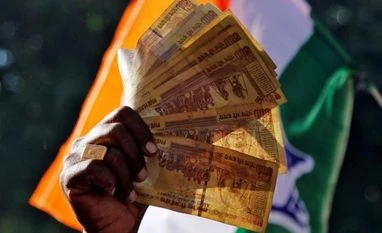
A man displays 500 Indian rupee notes during a rally organised by India's main opposition Congress party against the government's decision to withdraw 500 and 1000 Indian rupee banknotes from circulation, in Ajmer (Photo: Reuters)
Subhomoy Bhattacharjee
Last Updated : Feb 28 2017 | 7:11 PM IST
The one number to read from the second advance estimates of national income for the year 2016-17 was how much of a sucker punch has been demonetisation for the Indian economy. 

At 6.6% the estimate of Gross Value Added (GVA) at basic prices for the October-December quarter has pushed down India’s GVA for the year to 6.7%. Gross Value Added is defined as the value of output less the value of intermediate consumption. The data was released by the ministry of statistics and programme implementation on Tuesday. This is far better than what was anticipated as the table shows and would indicate that demonetisation has crucially not cut down consumption in the economy, contrary to dipstick indicators. 

Based on the strong reading, the first advance estimate for the year had put the GVA growth rate at 7%. The government advanced the date by a month to 6th January to account for the new budget dates introduced from this fiscal. Statisticians add to GVA, the value of taxes on products and deduct subsidies to arrive at the conventional gross domestic product (GDP). 

All research agencies had forecast that the GVA and GDP estimates for the Indian economy will slip because of the slowdown in consumption in the economy, due to demonetisation. Private final consumption expenditure as per Tuesday’s data accounts for 58% of the GDP for the Indian economy. A slowdown here was bound to have adverse impact on the economy. Even without the impact of the demonetisation private consumption had eased up from last financial year in the first two quarters to 55.2%. It has improved since. Slower growth rate of salaries and a weaker job climate due to low investments by Indian companies and a similar weakness in the global markets had already made consumers cautious. 

The impact of demonetisation is thus expected to wear off far more quickly. The RBI in its February Bi-Monthly assessment of the economy had estimated there will be 35 basis points impact on the growth economy. Tuesday’s figures show it is even less. 

According to the central bank, “Growth is expected to recover sharply in 2017-18 on account of several factors." It lists them as rebound in spending by consumers as cash comes back into the economy, which in turn should spur retail services; further easing of bank funding to projects as banks have higher liquidity and the emphasis in the budget on higher capital spending. 

One subscription. Two world-class reads.

Already subscribed? Log in

Subscribe to read the full story →
*Subscribe to Business Standard digital and get complimentary access to The New York Times

Smart Quarterly

₹900

3 Months

₹300/Month

SAVE 25%

Smart Essential

₹2,700

1 Year

₹225/Month

SAVE 46%
*Complimentary New York Times access for the 2nd year will be given after 12 months

Super Saver

₹3,900

2 Years

₹162/Month

Subscribe

Renews automatically, cancel anytime

Here’s what’s included in our digital subscription plans

Exclusive premium stories online

  • Over 30 premium stories daily, handpicked by our editors

Complimentary Access to The New York Times

  • News, Games, Cooking, Audio, Wirecutter & The Athletic

Business Standard Epaper

  • Digital replica of our daily newspaper — with options to read, save, and share

Curated Newsletters

  • Insights on markets, finance, politics, tech, and more delivered to your inbox

Market Analysis & Investment Insights

  • In-depth market analysis & insights with access to The Smart Investor

Archives

  • Repository of articles and publications dating back to 1997

Ad-free Reading

  • Uninterrupted reading experience with no advertisements

Seamless Access Across All Devices

  • Access Business Standard across devices — mobile, tablet, or PC, via web or app

Next Story



