Someone recently asked me why James Bond always insists on his drink being “shaken” and “not stirred”. I would concede that even though I have a lot of free time given that I am a journalist — a profession that epitomises disguised unemployment, at least in India — I had not bothered about this choice of words. But come to think of it, not everything can be both shaken and stirred. Some can only be shaken, and not stirred. For instance, Modi Sarkar’s approach to Aadhaar.
Before someone slaps a criminal defamation suit, allow me to give you proof. Page 8 of The Indian Express (Thursday’s Delhi edition) features an interview with Ravi Shankar Prasad, Union Law and Information & Technology Minister of the world’s fastest-growing (major) economy and the world’s largest democracy. The context was the Supreme Court of India’s long-awaited verdict on Aadhaar’s validity and use. He was asked: “Amid the criticism over surveillance, snooping and invasion of privacy, do you take this as a moral victory?” His answer: “It’s a vindication. Vindication because, what was hilarious for me, the biggest supporter of the right to information became the biggest patron of the right to privacy. When they were wearing the jhola of RTI, everything should be open, what I write in my file should be known to them. When Aadhaar came, they became the biggest champion of privacy…”
Clearly, Mr Prasad thinks that citizens’ right to information from the government, which the citizens have elected and instituted in the first place, about how it governs them cancels out their fundamental right to privacy as if the two rights in question were the numerator and denominator in some mathematical equation. The denseness of this approach can only be shaken — as it happened yesterday, thanks to the apex court’s ruling — and not stirred. For the paucity of space available for this column, I don’t want to get into explaining why this approach of Modi Sarkar is, to put it in an ultra mild form, both embarrassingly ignorant and alarmingly dangerous for the common people and their rights.
But, I suspect that this is not just an innocuous misunderstanding about the nature of rights by our law minister and our prime minister. Indeed, Mr Prasad is highly regarded as a lawyer and the PM knows the entire political science. I also suspect that had Mr Prasad been in the Opposition at present, and a sitting law minister of the Congress party had said something to this effect, he would have lampooned, instead of being lampooned. Indeed, when Aadhaar was being pushed by the Congress in the past, it was stridently opposed by the BJP, with the current prime minister leading the charge.
Of course, politicians do a somersault after coming to power. Something similar seems to have happened with Mr Modi as well. From bitterly opposing Aadhaar’s use, he started proselytising the new technology when he came to power (indeed, this was not the only issue on which Mr Modi did a volte-face — but that’s cause for another column another time). He became its most effective messenger and was wildly more successful than the previous prime minister, or anyone in that regime for that matter. I do not know what drove him but it does not reflect well on his government’s claim of saaf niyat, that in his push for Aadhaar, he forgot why it was thought of in the first place.
At the time of its inception, Aadhaar was presented to the people of this country as a tool — voluntary one at that — to give identity to the millions of faceless poor who have no way to back up their claim that they are who they say they are. Indeed, this was a genuine issue. It was argued that in the absence of any valid identification, the government fails to effectively and efficiently provide relief — in the form of subsidised foodgrains or some monetary assistance — to such people. For the sake of argument, this lack of identification of the faceless poor was blamed for India’s leaky subsidy disbursals. In a way, all the ills of lousy governance were being pinned on this one thing — the inability to identify and authenticate the poor. Even at that time, many resisted this view and argued in favour of providing greater transparency at the local level and bolstering social audits to ensure that the deserving do not miss out. That debate has still not been resolved.

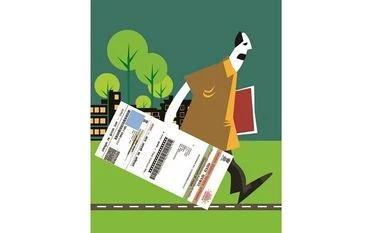 "Saaf niyat's Aadhaar shaken")












 Connect with us on WhatsApp