Editorial: Why can't India's politicians talk specifics?
Why is it so hard for India's political leaders to explain what it is they want and plan to do?
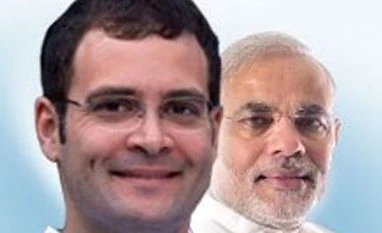
Business Standard Editorial Comment New Delhi It is not too much to ask that, on a day when the most prominent campaigners for India's two biggest parties speak simultaneously to large political rallies, some sense of what the future holds for the country be revealed. After all, by all accounts, India is suffering through at best a business-cycle slowdown, and at worst a breakdown in its development model. And even if this is just a cyclical slowdown, the damaging effects on employment and on education, given India's young population, could well be lasting. It is not too much to ask, therefore, of Rahul Gandhi and Narendra Modi: what would you do? How would you solve India's current problems? But on the strength of Sunday's speeches, there would be no answers.
It is not as if the speeches by either Mr Gandhi or Mr Modi were empty of content. Mr Modi insisted to a vast crowd in Patna, for example, that poor Hindus and poor Muslims wished not to fight each other "but to fight poverty". This is no doubt a step in the Gujarat chief minister's continuing attempt to distance himself from his record on communal polarisation; but as a statement of policy intent, it is empty. Meanwhile, Mr Gandhi's speech in Delhi was mercifully free of the family stories that have marred some of his recent outings - but again, all he offered was an affirmation that the Congress would continue to work for the "aam aadmi", or common man, not a programme for inflation, for unemployment, for growth or even for future redistribution.
True, both men have spoken about policy issues in the past. But they have done so purely to extol or defend the achievements of their respective governments or parties. Mr Modi has never tired of praising the achievements of his government in Gujarat - which are considerable, but perhaps not as sweeping as Mr Modi or some of his supporters would like to believe. Meanwhile, Mr Gandhi speaks often of the number of roads built by the United Progressive Alliance (UPA) government at the Centre - which he argues were more than those built by the previous, Bharatiya Janata Party-led National Democratic Alliance, a highly debatable claim. He has also praised the UPA's various entitlement schemes. In Delhi on Sunday, he claimed the Congress government in the city-state had "changed the face of Delhi" for the better, and cited the new airport, flyovers and the Metro rail network as examples. But neither he nor Mr Modi offered any programme for the future.
Why is it so hard for India's political leaders to explain what it is they want and plan to do? It is not as if Indian voters are stupid. Nor is the economic downswing irrelevant to their lives - most likely understand that it might hit them personally if it intensifies. And yet, voters are treated to banalities and generalities. If Mr Gandhi wishes to overcome his image as a dilettante who is averse to responsibility and the nitty-gritty of policy dispute, he will have to take a stand on what future policies he prefers, and how he intends to boost growth and employment in the medium term, not just over generations. And Mr Modi's praise for his own record will eventually run out of gas if he does not lay out a plan that is as bold as his words.

 "Editorial: Why can't India's politicians talk specifics?")


 Connect with us on WhatsApp