Undoing India-Pakistan mistrust

The Covid-19 pandemic offers an opportunity to normalise trade between the two countries, since both are searching for ways to restore livelihoods that have been destroyed by lockdowns
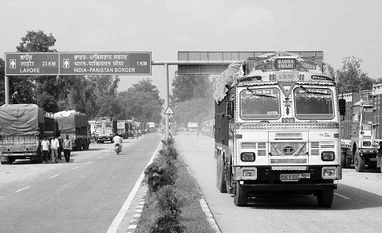
Truck, India-Pakistan
File photo of trucks at the Attari border. There is a huge gap between actual trade (prior to the additional barriers imposed in 2019) and the potential
Sanjay Kathuria
6 min read Last Updated : May 09 2020 | 7:59 PM IST
The ongoing Coronavirus-induced humanitarian crisis affords India and Pakistan an opportunity to bring trade back into play, and to thereby chip away at deep mistrust on both sides. Both economies are searching for ways of gradually restoring livelihoods that have been shattered by the lockdowns. This is where bilateral trade, virtually suspended since 2019, comes into the picture. 

Trade relations between the two largest economies of South Asia have always been turbulent. For a few years after Partition, India was Pakistan’s largest trading partner. But trade plummeted after the 1965 and 1971 wars. In 1996, India accorded “Most Favoured Nation” (MFN) status to Pakistan, a fellow World Trade Organisation member, but this was never reciprocated. Starting in 2011, Pakistan made several attempts to provide MFN (or “Non-Discriminatory Market Access”, Pakistan’s preferred nomenclature) status to India, but fears of being swamped by Indian goods ultimately prevailed.

Trade relations touched a new low in 2019, when, following the terror attack in Pulwama in February, India withdrew MFN status for Pakistan, and followed it up with an imposition of 200 per cent customs duty on all imports from Pakistan. In August 2019, following India’s enactment of the Jammu and Kashmir Reorganisation Bill, Pakistan suspended bilateral trade with India. 

The Covid-19 crisis provides an opportunity to begin the process of normalising India-Pakistan trade. What are the relevant considerations? 

One, the crisis opens political space — often in short supply on this matter — in both countries. Leaders can explain to their respective domestic constituents that unprecedented times require bold decisions, and that their primary goal is to use open trade to minimise disruptions to workers and households. 

Two, there is a huge gap between actual trade (prior to the additional barriers imposed in 2019) and the potential. In my work with Nadeem Rizwan and Priya Mathur in a recent World Bank report (A Glass Half Full: the Promise of Regional Trade in South Asia, http://hdl.handle.net/10986/ 30246), we show that as opposed to formal recorded trade of about $2 billion in 2015, potential trade between India and Pakistan could be as high as $37 billion.

By definition, trade takes place when there is a mutually beneficial exchange between the buyer and the seller. No one forces consumers to buy — they purchase because they benefit, or in other words, generate consumers’ surplus. It is the man-made barriers that prevent such gains from being realised on both sides.

The enormous gap of $35 billion between actual and potential trade implies significant welfare losses to the people of both countries, since the restrictions on bilateral trade imply that it has to be substituted by less efficient alternatives, including, for example, the re-routing of Pakistani and Indian exports to each other via Dubai (see, for example, the paper by Nisha Taneja and Samridhi Bimal (http: // www.icrier.org / pdf / Working_Paper_327.pdf). Apart from consumer goods, potential trade between India and Pakistan could encompass some dynamic value chains centered round sectors such as garments and textiles, automobiles and parts, and medical services, drugs andmedical devices. 

Three, the virtual suspension of trade in 2019, imposed on an already low level of commerce between the two countries, has created fundamental hardships among stakeholders. Pakistan’s exports to India fell from a monthly average of $45 million in 2018 to $2.6 million over March-July 2019. A recent report by Afaq Husain and Nikita Singla (http://briefindia.com/unilateral-decisions-bilateral-losses) shows, on the basis of detailed field work, that over 9,000 families in Amritsar that were dependent on bilateral trade were directly affected by the disruptions.

Consumers suffer — the retail prices of rock salt in Amritsar, for example, more than doubled. Three-quarters of the Rs 30 crore that was being added to the local economy of Amritsar was lost. Similarly, in Jammu and Kashmir, 900 families were directly affected as a result of suspension of trade across the Line of Control. Similar losses can be expected in Pakistan. Only the resumption of regular trade can alleviate the hardships of traders, labourers, truckers, consumers, and so on. 

Four, from a Pakistani perspective, normalising trade with India has a compelling logic, perhaps more than ever. Even before 2019, Pakistan’s merchandise exports to India were very low, at an annual level of $300-400 million. Over time, as India opened up its market to the least developed countries of South Asia in 2011, and operationalised a free trade agreement with Sri Lanka in 2000, Pakistan had to export to India on less favourable market access terms than any other country in the region.

File photo of trucks at the Attari border. There is a huge gap between actual trade (prior to the additional barriers imposed in 2019) and the potential

Prior to 2019, India maintained a sensitive list of 614 products for imports from Pakistan where tariff concessions under the agreement on the South Asian Free Trade Area would not apply, even as Pakistan imposed a negative list of 1,209 products that could not be imported from India. These mutual restrictions have cost both countries, but Pakistan’s limited access to a vast Indian market has affected its overall export performance. Thus, in our trade model cited above, Pakistan’s potential exports to India in 2015 were about $18 billion. Had this been realised, Pakistan’s global exports would have risen by over 80 per cent. India’s exports to Pakistan are also projected at about $18 billion, not a trivial amount even for India. 

If the crisis enables India-Pakistan trade discussions to be kick-started, reasonable goals would be immediate restoration of the pre-2019 dispensation (actual trade will of course need to follow the lockdown rules and guidelines for its easing) and achieving at least MFN trade in a finite time period. The transition period to move to MFN trade can be calibrated, with appropriate safeguards for products that Pakistan deems sensitive. There is plenty of global precedent for phased trade liberalisation, and this can be drawn upon, not least from the India-Sri Lanka Free Trade Agreement. In fact, having just concluded a Phase-II Free Trade Agreement with China, Pakistan should find that experience useful in negotiating MFN with India.

It is time to move on.
The writer is former lead economist and coordinator for regional integration in South Asia at the World Bank

One subscription. Two world-class reads.

Already subscribed? Log in

Subscribe to read the full story →
*Subscribe to Business Standard digital and get complimentary access to The New York Times

Smart Quarterly

₹900

3 Months

₹300/Month

SAVE 25%

Smart Essential

₹2,700

1 Year

₹225/Month

SAVE 46%
*Complimentary New York Times access for the 2nd year will be given after 12 months

Super Saver

₹3,900

2 Years

₹162/Month

Subscribe

Renews automatically, cancel anytime

Here’s what’s included in our digital subscription plans

Exclusive premium stories online

  • Over 30 premium stories daily, handpicked by our editors

Complimentary Access to The New York Times

  • News, Games, Cooking, Audio, Wirecutter & The Athletic

Business Standard Epaper

  • Digital replica of our daily newspaper — with options to read, save, and share

Curated Newsletters

  • Insights on markets, finance, politics, tech, and more delivered to your inbox

Market Analysis & Investment Insights

  • In-depth market analysis & insights with access to The Smart Investor

Archives

  • Repository of articles and publications dating back to 1997

Ad-free Reading

  • Uninterrupted reading experience with no advertisements

Seamless Access Across All Devices

  • Access Business Standard across devices — mobile, tablet, or PC, via web or app

More From This Section

Disclaimer: These are personal views of the writer. They do not necessarily reflect the opinion of www.business-standard.com or the Business Standard newspaper

Topics :India Pakistan tiesMost Favoured NationJammu and Kashmir

Next Story



