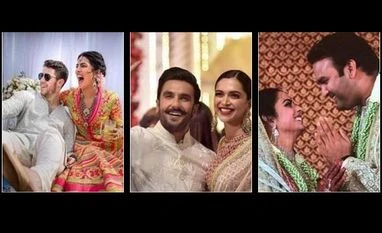
On specific metrics of economic performance such as per capita income, poverty, gross domestic product (GDP), and so on, the People’s Republic of China outstrips India by a long margin. On soft power, it is fair to say that India dominates, with Indian cuisine, Bollywood and yoga. Increasingly, however, India is gaining a global reputation for another element of soft power — the Big Fat Indian Wedding. It is uncertain whether the image is entirely benign. One of the many ironies of this notoriously unequal country is that the uber-lavish spending has earned the Indian wedding its somewhat dubious global reputation.
Consider this: In 2017, India sat 140th out of 193 countries in the ranks of nominal per capita income. The average spending on weddings in India, however, surpasses that of the United States, the world’s largest economy and seventh in the per capita rankings, by several orders of magnitude. Here is one index. In 2014, Fortune published an article on the business of Indian weddings in the US — the diaspora faithfully reflecting social trends back home. It showed that an average American wedding cost $29,000 and had 140 guests. In contrast, the average Indian wedding in the US cost $65,000 with 500 guests. Today, according to the Reliance Capital website, the Indian wedding business is a Rs 1 trillion industry and is growing at 25 to 30 per cent a year.
These numbers mask the massive tamasha that Indian weddings have become. For many self-respecting Indian billionaires, a wedding of their children covers entertainments for at least five days and has the following mandatory accoutrements. A destination: In India, the Rajasthan forts are top of the pops but Istanbul, Italy, Spain, Thailand, Switzerland or a Greek island in which stay and travel of guests is paid for; entertainment laid on by Bollywood’s top actors; cuisine by multiple leading chefs (Michelin-starrers, if possible); only the most expensive liquor; “return gifts” for guests sourced from top designers. This, of course, excludes the caparisoned elephants/horses, the multiple designer costumes for bride and groom (the wedding outfit alone must cost millions), the foreign bridal shower, the top-destination honeymoon, the Mercedes/Rolls Royce/Maybach that comprise the weddings gifts, the billions’ worth of jewellery, the top photographers and videographers to record the event and so on. Legends of over-the-top weddings have become commonplace, not least because the competition is acute. As a result, 24-carat invitation cards invite a flicker of interest but little more.
Celebrities often get their weddings paid for by offering a publication exclusive coverage rights. For others, a new source of funding has emerged: That of foreigners paying hard foreign exchange to attend an Indian wedding. Though it is well-established that in many developing countries where women’s rights are weak, marriage, especially arranged marriages, is an entirely transactional institution, the innovation of “paying guests” surely surpasses all standards of brashness.
All this is a long way from the time the government exhorted the citizenry to limit weddings feasts to one meat dish and one cereal. True, big-ticket weddings have many spin-off benefits, especially in galvanising the gig economy — the tent-wallahs, bands, the couture business, caterers, decorators, flower arrangers, hair stylists, mehendi specialists, and so on. But this ostentatious, event-management approach often comes at the cost of traditional sociability and dignity of Indian hospitality, where, for example, family members chipped in to look after guests. On balance, the hard realities intrude on this model of India’s soft power.