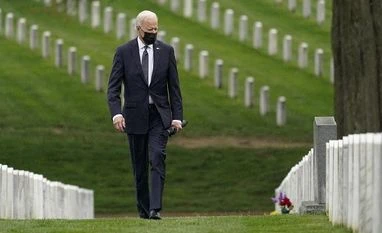
US President Joe Biden’s abrupt announcement of withdrawal from Afghanistan by September 11, the 20th anniversary of the attack on the World Trade Center in New York, has caught regional players unawares and is unlikely to be good news for any of them. Unlike the deal signed by his predecessor, Donald Trump, for a withdrawal on May 1, subject to steps such as the Taliban refusing shelter to Al Qaeda and agreeing to a dialogue with the elected Afghan government, Mr Biden has made the withdrawal unconditional. His announcement overrides Secretary of State Anthony Blinken’s March proposal for talks under UN auspices for a consensus plan involving the major stakeholders such as the US, Russia, China, Pakistan, and India. Taking their cue, Nato and Australia have also decided to withdraw from Afghanistan. As with Vietnam, the US-Nato withdrawal condemns the country to an all-out civil war between Ashraf Ghani’s elected government in Kabul and the Taliban, which controls about 20 per cent of Afghanistan’s 325 districts and has made it abundantly clear that it plans to re-establish its Islamic Emirate.
The earlier experience with Taliban dictatorship (1996-2001) suggests that the country will rapidly erase any gains it had made over the past 17 years of democracy, however imperfect. Mr Biden’s abrupt decision may be a realistic recognition of the weariness of the American public with the country’s longest-running overseas war that, like Vietnam, brought the superpower no tangible gain, is a heavy drain on the exchequer, and a distraction as the country struggles to recover from the ravages of Covid-19. Indeed, jihadism is not the danger that afflicts US society today; it is the lack of gun control laws that result in American citizens killing one another at will. Even so, US withdrawal will cause all-round destabilisation in the precarious balance of power in the region. The development should bring mixed gains for Pakistan, which has historically viewed Afghanistan as offering “strategic depth” against India. The Taliban is the Pakistan ISI’s creation and the country provided shelter to the organisation’s refugees after the US invasion. But with the country’s economy on life support, this proxy reassertion of regional power may be Islamabad’s poisoned chalice. The resumption of the ceasefire with India in March was largely seen as a move towards allowing that country some breathing space as it battles Covid-19 and economic meltdown.
It is also clear that Pakistan’s principal patron, China, already unhappy with the progress of its projects in the country, will not view with equanimity the sponsorship of freelance jihadism in Afghanistan when it faces its own challenges from the Uighur minority. The imminent resurgence of the Taliban is, however, the worst news for India, which has enjoyed good relations with Kabul’s elected governments, thanks to its multiple humanitarian projects. It was the Taliban that supported the militants who hijacked the Indian Airlines aircraft in 1999 and forced the release of several jailed terrorists who proceeded to direct the upsurge of terrorism in Jammu & Kashmir. A powerful Taliban raises the spectre of renewed terrorism in the new Union Territory of Jammu and Kashmir at a time when dissatisfaction over the abrogation of Article 370 still simmers and a crackdown on civil rights continues. Then there is unfinished business with China along the Line of Actual Control to contend with. Extreme destabilisation in a nuclear-armed region is the last thing the world can afford.

 "Withdrawal symptoms")












 Connect with us on WhatsApp