With the cost of education in India and abroad having increased significantly over the past few years, providing finances for higher education for one's children, has become as important a financial goal as buying a house or planning for retirement. Hence, it requires proper and systematic financial planning.
Lets look at the steps involved in financial planning for higher education.
Determine one's current financial situation: Gathering details about finances - that is, your current income, expenses, savings, debts and investments.
Estimate funds required: Researching the course your child wants to pursue and keeping note of the funds required in future for meeting such higher education plans.
Identify alternative course of action: Life is uncertain, so you must always be ready with alternative courses of action. For example, choosing alternative educational institutions (in case your child fails to secure admission in the institution that is his or her first choice), curbing unnecessary expenses and so on will help. While deciding on an alternative course of action you need to assess the risk and time value of money. You also need to consider personal values and economic factors.
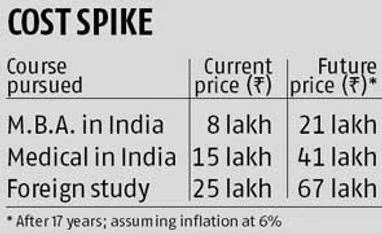
Create and implement your financial plan: You should create a financial plan that takes into account the future costs of education and not just the current costs - this will mean budgeting for inflation, interest cost variations, and so on. For example, if your child is three years old now and you are planning for his or her education after the age of 20 years, the cost of education could look something like this:
You should consider the investments already made, such as Public Provident Fund (PPF), mutual funds, and so on for this purpose, and deduct it from the total corpus required.
For example, if there is already an investment worth Rs 20 lakh in various instruments, then the total funds required (assuming foreign study in our example above) would be Rs 47 lakh, which can now be amassed over 17 years.
Now let us consider the various investment options: 1) You could be invested in a PPF as it gives you tax free fixed interest rate, principal security and income tax deduction.
2) Investing in a Systematic Investment Plan of a mutual fund, will give better returns than most instruments - but at higher risk of capital loss.
3) One can save by creating a trust for children. One needs to make an irrevocable transfer to the trust, where money cannot be claimed back by the donor. All investments are made through the trust and the income generated can only be used in accordance with the purpose of the trust. The income from the investments is not clubbed with the donor's income, but the trust needs to pay the tax.
4) It is not wise to invest directly in equities with the money set aside for your child's education, as there is a lot of uncertainty in the stock markets and you could end up losing the invested money. Debt instruments would be a wiser option.
5) In case of any shortage, your child could opt for an education loan, which he/she could repay after her graduation. However, consider the monthly repayments, collaterals and interest rates before taking up such loans.
Interest paid on these loans are also fully deductible from taxable income under Section 80E up to eight continuous years, starting from the year in which the interest is first paid.
Tax benefits Another area to keep in mind while planning for child's education is the tax benefits one is eligible for.
A parent can claim a deduction of payment made for tuition fee to any university, college, school or any other educational institution. The deduction on payments made towards tuition fee can be claimed up to Rs 1 lakh together with deduction in respect of insurance, provident fund and pension. It can only be claimed in respect of two dependent children and for fees to an educational institution within India and for tuition fee only.
Review and revise financial plan: A financial plan is personalised and unique. This plan should be monitored and revised regularly keeping personal goals in consideration to ensure proper outcomes.
The writer is a certified financial planner

 "A financial planner for education")


 Connect with us on WhatsApp