Brown is the new black in shoes for the aspiring Indian male office goer

Indian males are opting for stylised brogues and heels, while double monk and loafers are making inroads into the formal footwear range dominated thus far by closed-lace Oxfords and Derbys

Shoe
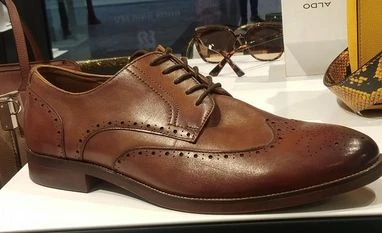
The safest bets in men’s formal shoes are Oxford shoes that come with closed lacing. Check out this one from Aldo for Rs 12,999
Namrata Kohli New Delhi
8 min read Last Updated : Feb 09 2020 | 10:33 PM IST
Whether or not you have a shoe fetish, there are a few must-have items of formal footwear that every officegoer needs to keep in his shoe wardrobe. Conventional classics, such as the Oxfords with closed lacing or Derby with open lacing continue to rule. The main difference between these two lies in the laces. While an Oxford is foot hugging, the Derby has quarters stitched on top of the vamp, making it less-bound in both appearance and fit, and the looser tightened laces allow for more freedom of movement. Oxfords are good for everyone looking for a good formal fit, but Derbys are particularly recommended for people with broader feet.

Valued at $5,977 million in 2019, the men’s footwear market in India is projected to reach $6,656 million in the current calendar, according to market research provider, Euro monitor International. Of the global annual production of 23 billion pairs, 2,200 million pairs are made in India, says Ishaan Sachdeva, Director, Alberto Torresi. He says, “India is the second-largest footwear supplier, after China. Gender-wise, men’s footwear dominates the Indian market, capturing around 58 per cent of the total share and is expected to grow at a 10 per cent CAGR by 2020.”

The ideal shoe closet

A few must-haves are a pair of brown oxford shoes and black Derbys. Even loafers are trending – in fact, brands known for their conventional classics and their black and brown shoe range of formal Oxfords and Derbys, have started keeping loafers and mocassins, in a big way now. However, shoes with tassals and buckles and shiny stuff are a no-no for regular office wear, but good for office brunches, casual meetings and such like.

The toe of a shoe will almost certainly be noticed first. Its shape and decoration is an important style consideration. From round and square to almond shaped and pointed, the toe leads the way in many shoe purchases. “Cap-toe shoes are back in trend,” says Harkirat Singh, Managing Director, Aero Club (The maker of Woodland and Woods). A cap-toe is any kind of shoe that has horizontal stitching across the toe box, which extends to the welt on either side, thus forming a “cap” on the toe. These often come with decorative punched called brogues, detailing and serrations along the toe-cap edges and in the centre of the cap.

Brogues are a style of low-heeled boot that historically originated from Scotland and Ireland. It is made using untanned hide with small perforations, the purpose of which was functional - to allow water to drain through the footwear when the wearer walked in wet terrain. The design has since evolved, and the perforations are now mostly decorative. The market is full of different types of Brogues. Designs include the full brogue (wingtip), half brogue and quarter brogue. Full brogues are the most iconic style and feature a pointed toe cap with wing-like extensions that run along both sides of the shoe. When viewed from the top the toe cap looks as though it has a ‘W’ or “M” shape. Half and quarter brogues are considered ideal choice for business and formal occasions but overall brogues are versatile and can suit everything from blue jeans to two-piece suits.

Heels are back and how. “Yes, a heavy sole with heels was everybody’s favourite in 2019 and will continue to rule the market this year,” confirms Tabby Bhatia, Founder of Brune. The high-heeled shoe - the ultimate piece of fashionable footwear - has come a long way and remains symbolic of fashion, style and class, says Harkirat Singh, adding that the other big trend is formal loafers being in demand.

In colours, brown is the new black, with fifty shades of the colour dominating the shoe wear market. Neutral shades have always been in demand. “For men, black, yellow and brown tan are the trendiest colours in leather so far as far as pairing with a shirt and leather jacket is concerned," says Bhatia of Brune. He adds that this year will also see the sole game on peak, apart from shoe designing. "You will find variant modifications in casual heavy shoes like buckle, zardozi and many more. Whereas, tassel, triple monk and fringes patterns are trending the most in oxford and loafers shoe styles," he adds.

Signature shoes with double monk strap (left, Price: Rs 10,999) and a double monk at Tresmode (Rs 14,000); Crocodile shoes to match your ensembles. Price: Rs 11,999. Courtesy: Rosso Brunello

 
Soul of the shoe? the shoe sole, of course

The best material for the sole of shoes is one that is durable, sturdy, and water resistant. It should also complement the style of the footwear. The most common materials are rubber and leather, though a variety of other materials such as polyurethane and PVC compounds are also used. But some of the ones preferred include TPR or Thermo Plastic Rubber which is a mixture of rubber and plastic and is known for elasticity, good wear resistance, skid resistance, soft extension. Also EVA (Ethylene-Vinyl Acetate) soles are popular – this is an insulating foam that does not absorb water, is elastic and tear- and slip-resistant.

Sole designing is another science in itself - certain brands are even using combination of materials such as rubber in outer and inner sole with leather in between. Then there is a new kind of air cube conditioning made by brand Ruosh to keep the shoe light.

Size does matter. And shoe makers realise this. Gone are the times when big shoes were impossible to find. Almost every brand has shoe sizes till 12 with some even having till 14.

What men want

The Indian male officegoer typically wants comfort, style and price, in that order, says Shivendra Bhat, Store Manager, Aldo at Vegas Mall, Dwarka. He adds that apart from genuine leather, there is interest in other materials such as suede and nubuck, which tend to be smoother.

Shoe care and maintenance is essential for shoe life. “I have seen reluctance of people to shell out Rs 1,000 for shoe care when they don’t bat an eyelid while spending 10,000 plus for shoes. But that is the investment you make for its longevity and the shoes easily last for three years,” says Bhat.

Is cherry the new hue in men’s formal footwear fashion? Hush Puppies thinks so

 
Maintenance 

It is important to occasionally clean your shoes with a leather cleaner or leather shampoo, and use a good quality brush to remove loose surface dirt. If your shoes are wet after cleaning, let them air-dry before your proceed with the next step; dry shoes in room temperature only and never expose them to the sun, heat from the sun will cause the leather to shrink, wrinkle, harden, dry, and crack. A lot of people who buy even Gucci and luxury shoes like some of Aldo care products, says Bhat. “You have leather protector (Rs 1,000 for 200 grams), sole cleaner (Rs 800), shoe shine (Rs 600), leather conditioner (Rs 950 for 225 ml), Aldo water resistant lotion (Rs 600) and multi protector (Rs 1,200 for 220 ml). In case you are travelling, what comes in handy are shoe cream clean wipes (Rs 600). Premium brands also offer a sticking and pasting service, which is free of cost for up to six months.

Are people buying shoes online or offline? The first preference of the customers has always been store shopping though the percentage of online shopping has also increased in the past two years, says Brune’s Bhatia. Buyers do the mix of both online and offline shopping as per the demand of the situation. “But touch and feel and offline shopping experience more appropriate in shoes shopping,” says Sachdeva.

All big shoe brands started out by having offline stores but they are aware of the dynamics of e-commerce penetration in India and today most of them have an online presence too. “We can clearly see the evolving journey of shoppers as the path of purchase crosses between physical and digital world and consumer’s today bounce between stores, desktops and mobile devices. Industry states more than 55% of consumers visit stores before buying online, thereby highlighting the need for a hassle free omni channel experience. Good thing we too are now an omni brand!” says Singh, “Typically, the need to touch and try is one of the primary needs of a first-time buyer, however repeat buyers are more than comfortable with online purchases.”

One subscription. Two world-class reads.

Already subscribed? Log in

Subscribe to read the full story →
*Subscribe to Business Standard digital and get complimentary access to The New York Times

Smart Quarterly

₹900

3 Months

₹300/Month

SAVE 25%

Smart Essential

₹2,700

1 Year

₹225/Month

SAVE 46%
*Complimentary New York Times access for the 2nd year will be given after 12 months

Super Saver

₹3,900

2 Years

₹162/Month

Subscribe

Renews automatically, cancel anytime

Here’s what’s included in our digital subscription plans

Exclusive premium stories online

  • Over 30 premium stories daily, handpicked by our editors

Complimentary Access to The New York Times

  • News, Games, Cooking, Audio, Wirecutter & The Athletic

Business Standard Epaper

  • Digital replica of our daily newspaper — with options to read, save, and share

Curated Newsletters

  • Insights on markets, finance, politics, tech, and more delivered to your inbox

Market Analysis & Investment Insights

  • In-depth market analysis & insights with access to The Smart Investor

Archives

  • Repository of articles and publications dating back to 1997

Ad-free Reading

  • Uninterrupted reading experience with no advertisements

Seamless Access Across All Devices

  • Access Business Standard across devices — mobile, tablet, or PC, via web or app

Topics :FootwearShoeslifestyle

Next Story





