How restaurants can overcharge you
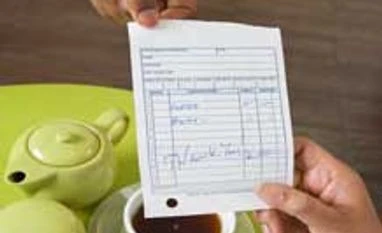
The tax component might be charged on the entire food bill, which is illegal. Read on for the other ways
Yogini Joglekar Mumbai Tax components have become a part of our restaurant bills to the extent that we rarely notice what all we'e paying for over the food cost. Most of us hardly understand the various taxes applicable on eating out.
To begin with, there are many who feel service tax and service charge are not different. It's not surprising if we don't know when or on what bill component both these are charged. We ought to: Service charge is levied for the service provided by restaurants, that is, the serving of food. And, service tax is to be paid only on this service provided by restaurants.
This means the service tax of 12.36 per cent should be applicable only on the service charge. "To pocket money from customers, many hotels/restaurants charge a service tax of 12.36 per cent on the entire food bill, which is incorrect," says M S Mani, senior director, indirect tax, at Deloitte India.
Given that many don't know the rates and its applicability, it's difficult to question the restaurant owner. There are only two main tax components to a food bill - service tax and value-added tax (VAT). Even if service tax can be levied on the entire bill, restaurants get an abatement on it. Assume there is 60 per cent abatement; only 40 per cent of the bill should attract service tax. This might not always be the case because most diners do not know about abatement or at least would not know the abatement rate on the relevant restaurant category. Some might choose to apply 4.9 per cent as service tax (12.36 per cent of 40 per cent of the bill).
"If you choose to sit in the non-air-conditioned (AC) part of a restaurant, you still have to bear service tax, as air-conditioning in any part of the restaurant premise will attract service tax," says advocate Shailesh Sheth. However, the food price will be lower in the non-AC part.
Some write 'inclusive of VAT (value-added tax) on the bills/menu. This means they have opted for a composition scheme under the government tax rule. This is allowed in three-star or lower rated restaurants. Here, the restaurant can charge five per cent VAT for a simpler accounting method. But, there are chances of your being charged 12 per cent instead of five per cent, as restaurants don't need to mention the VAT rate.
Though it's difficult to know what scheme a restaurant has opted for, it's best to ask if doubtful. VAT rates are state-specific and different for food and liquor. For instance, on food in Mumbai it is 12.5 per cent; on liquor, it's five per cent. Sachin Menon, partner & national head at KPMG India, says, "Make sure you are charged the right rates and insist on separate bills for food and liquor." Excise rules do not allow restaurants to club food and liquor bills, as the VAT is different.
Since 2011, only AC restaurants serving alcohol have had to pay service tax. From April 1, service tax will be applicable on even food served by AC restaurants. The good news is that restaurants will now have to mention the service tax and VAT registration number on bills. This will show authenticity and accountability. "If needed, you can file a complaint with the VAT anti-evasion authorities, if you suspect that you are being charged more and the restaurant is retaining the excess tax collected," says Mani.

 "How restaurants can overcharge you")


 Connect with us on WhatsApp